Volatile Organic Constituents of Clinopodium gilliesii(Benth.) Kuntze: Analysis by HS-SPME and classic hydrodistillation
Constituyentes Orgánicos Volátiles de Clinopodium gilliesii (Benth.) Kuntze: Análisis por HS-SPME e hidrodestilación clásica
DOI: http://dx.doi.org/10.23850/24220582.351
Ana María Vázquez1*, Mario Leandro Aimar2, María Florencia Decarlini1, Gabriela Inés Demmel1, Juan José Cantero3 and Gustavo Miguel Ruiz1.
1Facultad de Ciencias Químicas, Universidad Católica de Córdoba, Córdoba, Argentina.
2Departamento de Química, Facultad de Ciencias Exactas, Físicas y Naturales, Universidad Nacional de Córdoba, Córdoba, Argentina.
3Departamento de Biología Agrícola, Facultad de Agronomía y Veterinaria, Universidad Nacional de Río Cuarto, Río Cuarto, Córdoba, Argentina
Autor para correspondencia: ana.vazquez.s@gmail.com
Recibido: 23.08.2016 Aceptado: 27.10.2016
Para citar este articulo
Vázquez, A., Aimar, M.,Decarlini, M., Demmel, G., Cantero, J y Ruiz, G. (2016). Volatile Organic Constituents of Clinopodium gilliesii (Benth.) Kuntze: Analysis by HS-SPME and classic hydrodistillation. Rev. Colomb. Investig. Agroindustriales, 3(1), 91-100. DOI: http://dx.doi.org/10.23850/24220582.351
ABSTRACT
In the present research, an analytical methodology to micro scale based on the use of the HS-SPME/GC-MS to determine volatile compounds present in Clinopodium gilliesii (Benth.) Kuntze (Lamiaceae) was employed, and settled differences and similarities with its essential oil obtained by hydrodistillation. A systematic description of the volatile components of flowers, stems, leaves and combined aerial parts (whole plant) was constructed via GC-MS analyses of HS-SPME adsorbed compounds and of essential oils obtained through hydrodistillation of the same tissues. Piperitenone oxide and piperitone oxide were the main components of both the HS-SPME analysis and essential oil analysis. The HS-SPME method can achieve comparable results to those obtained by essential oil analysis, by using very fewer samples, a shorter extraction time and a much simpler procedure.
Key words: Essential oil, piperitenone oxide, piperitone oxide, volatile organic compounds.
RESUMEN
En el presente trabajo se empleó una metodología analítica a micro-escala basada en HS-SPME/GC-MS, para determinar los compuestos volátiles presentes en Clinopodium gilliesii (Benth.) Kuntze (Lamiaceae), y se establecieron diferencias y similitudes con su aceite esencial obtenido por hidrodestilación. Se realizó una descripción sistemática de los componentes volátiles de flores, tallos, hojas y partes aéreas combinadas (planta entera) a partir de los análisis por GC-MS, a través del sistema HS-SPME y de los aceites esenciales. La piperitenona y el óxido de piperitona fueron los componentes principales tanto del análisis por HS-SPME, como del aceite esencial. El método de HS-SPME puede lograr resultados comparables a los obtenidos por el análisis de aceite esencial, mediante el uso de muestras de menor tamaño, un tiempo de extracción más corto y un procedimiento más simple.
Palabras clave: Aceite esencial, compuestos orgánicos volátiles, óxido de piperitenona, óxido de piperitona.
INTRODUCCIÓN
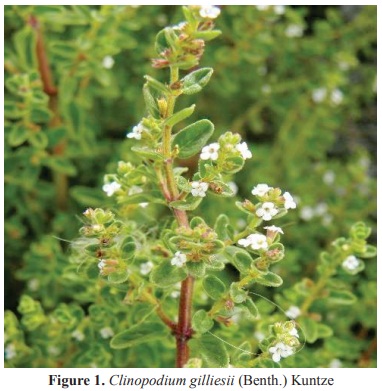
Clinopodium gilliesii (Benth.) Kuntze (Lamiaceae, synonymy Satureja parvifolia (Philippi) Epling, figure 1) is an aromatic plant that grows in Perú, Chile, Bolivia and at the verge of rivers descending from the hills in the northwestern provinces of Argentina (Salta, Jujuy, Córdoba, Catamarca, Tucumán, La Rioja, San Juan, San Luis). In our country it is known with the common name of “muña muña” (Barbosa et al., 2006) and is popularly used for its aphrodisiac properties (Viturro et al., 2007). Usually found in health food local stores marketed as vegetable crude drugs and its production comes entirely from wild collection. So that, this species supports a high extraction pressure resulting from its use in herbalism, yerba mate composite (traditional infusion).
The fresh or dried herb is used as a flavoring agent for aliments in cooking, and in traditional medicine of the people of the mountains, as aphrodisiac, digestive, stimulant, emm
enagogue, against altitude sickness, colds and female sterility (Viturro et al.,2007).
Moreover, investigations on this plant deal with the chemical composition and the antifungal activity of its essential oil (Viturro et al., 2007). Hnatyszyn et al.(2003), has reported a very interesting study related to ethnopharmacological use of this plant as aphrodisiac. In this work a systematic study of different extracts of C. gilliesii and other plants over relaxant activity in the smooth muscle of the corpus cavernosum on the Guinea pig was performed. As a result, the dichloromethane extract of C. gilliesii was very active in at a very low dose (2.5 mg.ml-1). Thus these results reported here give some scientific supports to one of the more traditional uses as aphrodisiac of this plant.
Additionally, other biological activities for this plant include, insect-repellent, antifungal and antibacterial (Oliveira et al., 2011).
Volatile Organic Constituents (VOCs) are defined as any organic compound with a boiling point in the range from (50° to 100°C) to (240° to 260°C), corresponding to having saturation vapour pressures at 25°C greater than 100 kPa. Studies on volatile composition of the essential oil obtained by hydrodistillation of aerial parts of C. gilliesii have indicated that piperitone oxide was the majoritary component. Additionally, pulegone, limonene, dodecanal, citronellol, sphatulenol, α- terpineol and menthone, were also present, although in smaller amounts. However, has also been reported that piperitenone oxide was the largest component and other majority component but in minor proportion were piperitenone and pulegone (Viturro et al.,2007). These differences in the composition of volatile compounds can be revealing the existence of chemotypes within this species.
Several techniques have been used to characterize volatile organic compounds present in plants, although hydrodistillation is themostcommonextractiontechnique employed to obtain essential oils from aromatic plants (Saroglou et al., 2006). However, this methodology is a laborious and time-consuming process that requires large amounts of sample and this represents a major problem when it has a very limited amount of sample, which is the classic problem that occurs when trying to establish the profile of volatile organic compounds present in specimens obtained by micropropagation.
Moreover, when investigators extract essential oils from a plant matrix to characterize the profile of VOCs, little attention is paid to the possibility that the extraction methods may yield different essential oil profiles, or even worse, sample degradation, despite it being well known that chemical reactions can occur during the distillation process (Babu & Kaul, 2007).
Furthermore, it is a simple and fast modern tool which is used to characterize the volatile fraction of aromatic and medicinal plants (Vázquez et al. 2014), offering a valid alternative to the classic Clevenger essential oil hydrodistillation for gas chromatographic analysis of volatile constituents.
To our knowledge, there are no enough reports in the literature about direct SPME analysis of volatile constituents on whole plants of C. gilliesii or their aerial parts. The aim of this research was to evaluate the HS-SPME/GC-MS method for the analysis of volatile compounds in this specie. Additionally, a comparison between the results obtained by HS-SPME and essential oil analyses on the characteristic GC-MS profiles was performed for both qualitative and semi-quantitative analyses of the VOCs from C. gilliesii.
MATERIAL AND METHODS
Plant Samples. Specimens of C. gilliesii in the process of flowering-fruiting were collected in the SierrasGrandes deCórdoba,Argentina (35°32’384”; 64° 33’ 252 O; altitude: 1663 meter above sea level). A whole plant was deposited in the Herbarium Marcelino Sayago (Register Number UCCOR 402), Faculty of Agricultural Sciences, at Catholic University of Córdoba. To perform the analysis of HS-SPME/GC-MS within 24 hs. of collection, samples (100.0 ± 0.1 mg) of aerial parts of fresh plants were previously chopped with a clean cutter and placed in glass vials of 20 cm3, which were sealed with Viton septa and aluminium seals provided by Supelco (Sigma-Aldrich, Argentina) (Figure1).
HS-SPME technique. The analytical conditions for HS-SPME analysis were previously established by the measurement and characterization of the volatile compounds present in samples of Clinopodium odorum (Griseb), Harley (Vázquez et al., 2014). Using a manual holder (Supelco), DVB-CAR-PDMS 50/30 µm fiber (Sigma-Aldrich, Argentina) was conditioned in the GC injector at 225°C for 8 hours before use.
The vials containing the samples of C. gilliesii were immersed in a thermostatic water bath at 40.0°C (PolyScience 8005, accuracy 0.2°C). After 10 min, the SPME device was inserted into the sealed vial by manually penetrating the septum, and the fiber was exposed to the sample headspace for 10 min. After extraction, the needle on the SPME manual holder was set to its maximum length in the GC injector and the fiber was directly exposed to the hot injector at 250°C for 5 min in splitless mode.
Essential oil of C. gilliesii. 500 g of aerial parts of plants were hydrodistilled for three hours. The aqueous distillate was extracted with chloroform (3 x 20 mL) and the organic layer was separated, dried over anhydrous MgSO4and filtered. The solvent was evaporated in a rotary evaporator (ambient temperature) to obtain 2.3 mL of essential oil (yield of 0.46% v/w). An aliquot diluted in hexane of the essential oil in hexane was injected into the chromatograph.
Gas Chromatography-Mass Spectrometry. The identification of volatile components was performed using a gas chromatograph HP 5890 Series II equipped with a manual injection port operating in a split/splitless mode and coupled to an HP 5970 Mass Detector. The column used was an HP-5 capillary column (30 m x 0.25 mm ID x 0.25 µ film). The working conditions were: injector: 225ºC; interface: 230°C, gas carrier: He 99.99%; head pressure: 5 psi; initial ramp: 40°C (5 min) - 90°C (2°C/min); middle ramp: 90-130°C (10°C/min); final ramp: 130-200°C (5ºC/min). The mass spectrometer was operated at 70 eV and the spectra were recorded in the range of m/z 30 - 550 amu in the acquisition mode “scanfull.” The data processing system used was the HP-MS ChemStation including database Wiley 275 and NIST.The volatile components were identified by comparing their mass spectra with library data (match > 90%) and by the determination of the respective Kovat´s retention indices (KI), (alkane standards provided by Sigma-Aldrich).
Statistical analysis. All analysis was done in triplicates. Modified ShapiroWilk statistic was applied to test data normality. One-way analysis of variance (ANOVA, α= 0.05) and Tukey'stest were carried out on quantitative data, in order to verify if there were significant differences in the composition of the samples of the different aerial parts of the plants. Data were analyzed using INFOSTAT software Version 2016 (Facultad de Ciencias Agropecuarias, Universidad Nacional de Córdoba, Córdoba, Argentina).
RESULTS AND DISCUSSION
HS-SPME of leaves. As can be seen in Table 1, the existence of 69 different components in the volatile fraction of leaves of C. gilliesii were established, 67 of which were successfully identified (97.1%). Thus, positive identification was achieved in 98.8% of the total area observed in the chromatogram.
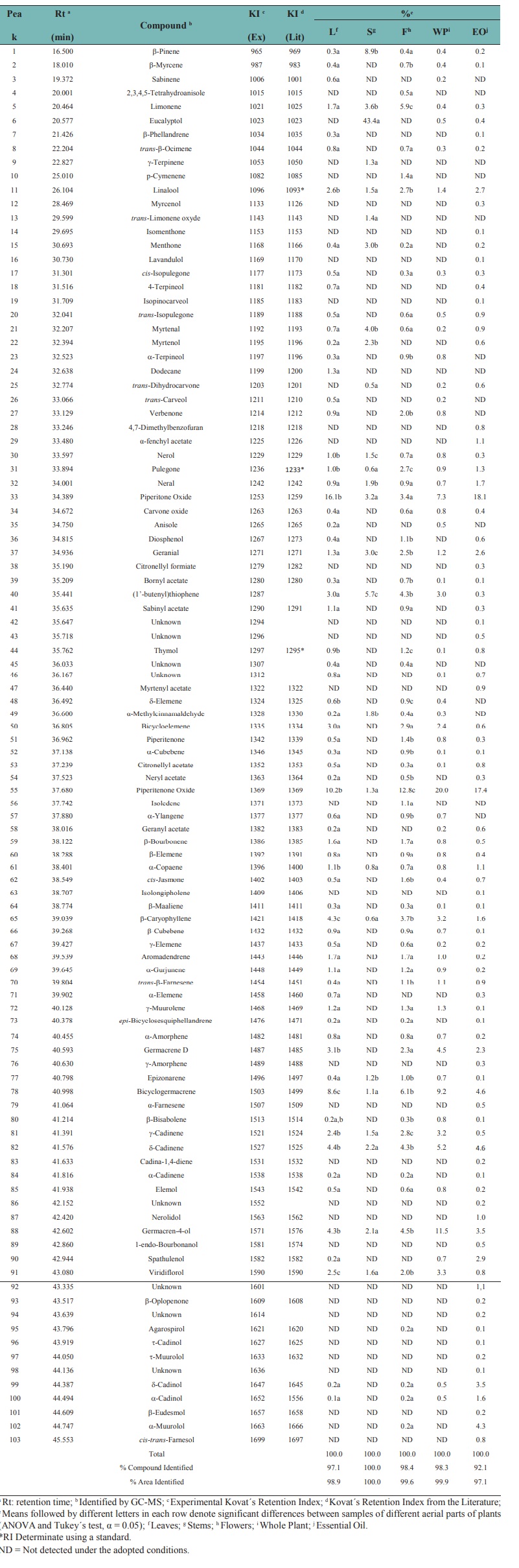
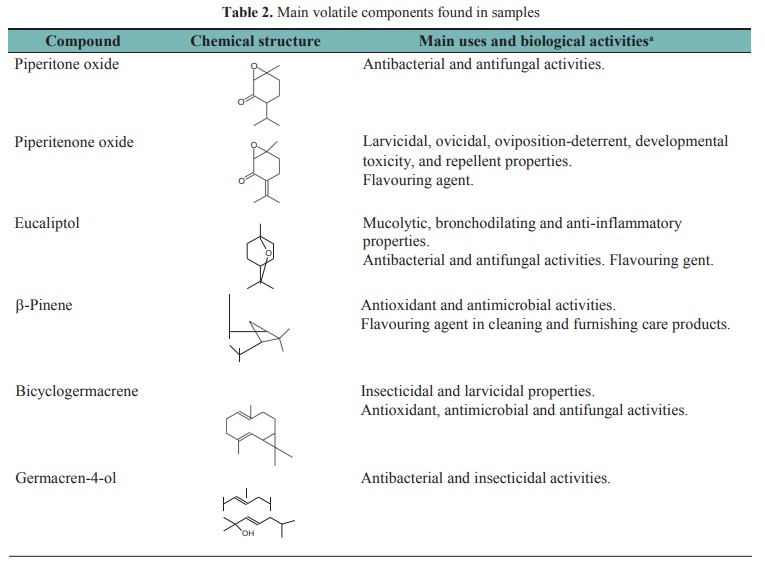
From measurements made on leaves of C. gilliesii (Table 1), the major components were piperitone oxide (16.1%) and piperitenone oxide (10.2%). Lower proportions were observed of bicyclogeremacrene (8.6%), δ-cadinene (4.4%), β-caryophyllen (4.3%), germacre-4-ol(4.3%), germacrene D (3.1%), bicycloelemene (3.0%), linalool (2.6%), viridiflorol (2.5%), limonene (1.7%), aromadendrene (1.7%), β-bourbonene (1.6%), geranial (1.3%), dodecane (1.3%), γ-muurulene (1.2%), sabinyl acetate (1.1%), α-gurjunene (1.1%), α-copaene (1.1%), nerol (1.0%) and pulegone (1.0%). The rest of the components were present at amounts ranging from 0.9% (for example verbenone) to 0.2% (for example neryl acetate and spathulenol, among others). Additionally, a compound identified like (1-butenyl)thiophene by MS was observed in 3.0%.
HS-SPME of stems As can be seen in Table 1, the existence of 26 different components in the volatile fraction of the stems of C. gilliesii was established and was successfully identified (100.0%). Thus, positive identification was achieved in 100.0% of the total area observed in the chromatogram..
In stems of C. gilliesii (Table 1), eucaliptol (43.4%) and β-pinene (8.9%) were observed to be the main components. All other compounds were found in appreciable amounts (>1%), for example: myrtenal (4.0%), limonene (3.6%), piperitone oxide (3.2%), menthone (3.0%), geranial (3.0%), myrtenol (2.3%), δ-cadinene (2.2%), germacren-4-ol (2.1%), neral (1.9%), α-methylcinnamaldehyde (1.8%), linalool (1.5%), γ-cadinene (1.5%), trans-limonene oxide (1.4%), piperitenone oxide (1.3%), γ-terpinene (1.3%), epizonarene (1.2%), and bicyclogermacrene (1.1%), were observed. The rest of the components were present at amounts ranging from 0.8% (α-copaene) to 0.5% (trans-dihydrocarvone, among others). Additionally, a compound identified like (1-butenyl) thiophene by MS was observed in 5.7%.
HS-SPME of flowers. As can be seen in Table 1, the existence of 63 different components in the volatile fraction of the inflorescence of C. gilliesii were established, 62 of which were successfully identified (98.4%). Thus, positive identification was achieved in 99.6% of the total area observed in the chromatogram.
Piperitenone oxide (12.8%) was found to be the major components. Additionally, appreciable amounts of bicyclogermacrene (6.1%), limonene (5.9%), germacren4-ol (4.5%), δ-cadinene (4.3%), β-caryophyllene (3.7%), piperitone oxide (3.4%), bicycloelemene (2.9%), pulegone (2.7%), geranial (2.5%), δ-cadinene (2.2%), verbenone (2.0%), were found. The presence of β-bourbonene (1.7%), viridiflorol (1.6%), piperitenone (1.4%), p-cymenene (1.4%), γ-muurulene (1.3%), thymol (1.2%), isoeledene (1.1%), trans-β-farnesene (1.1%), and diosphenol (1.1%), also were observed. The rest of the observed components were present at amounts ranging from 0.9% (α-terpineol) to 0.2% (agarospirol). Additionally, a compound identified like (1-butenyl) thiophene by MS was observed in 4.3%.
HS-SPME of combined aerial parts of the whole plant. As can be seen in Table 1, the existence of 59 different components in the volatile fraction of C. gilliesii were established, 58 of which were successfully identified (98.3%). Thus, positive identification was achieved in 99.9% of the total area observed in the chromatogram.
Table 1 summarizes the main components provided by the HS-SPME analysis of the aerial parts of the whole plant, with piperitenone oxide (20.0 %), germacren-4- ol (11.5%), bicyclogermacrene (9.2%) and piperitone oxide (7.3%) being found at the greatest proportions. In addition, there were also appreciable amounts of δ-cadinene (5.2%), germacrene D (4.5%), viridiflorol (3.3%), β-caryophyllene (3.2%), bicycloelemene (2.4%), γ-muurulene (1.3%), geranial (1.2%), and trans-β-farnesene (1.1%). The rest of the observed components were present at amounts ranging from 1.0% (aromadendrene) to 0.1% (thymol). Additionally, a compound identified like (1-butenyl)thiophene by MS was observed in 3.0%.
Essential oil analysis As can be seen in Table 1, the existence of 88 different components in the essential oil obtained by hydrodistillation of desiccated aerial parts of C. gilliesii were established, 81 of whichwere successfully identified (92.1%). Thus, positive identification was achieved in 97.1% of the total area observed in the chromatogram.
The major components present in the essential oil of C. gilliesi were piperitone oxide (18.1%), and piperitenone oxide (17.4%). There were also significant amounts of: bicyclogermacrene (4.6%), δ-cadinene (4.4%), α-muurulol (4.3%), δ-cadinol (3.5%), germacren4-ol (3.5%), spathulenol (2.9%), linalool (2.7%), geranial (2.6%), germacrene D (2.3%), neral (1.7%), β-caryophyllene (1.8%), pulegone (1.3%), α-copaene (1.1%), α-fenchyl acetate (1.1%), and nerolidol (1.0%). Other components were found at amounts ranging from 0.9% (myrtenal) to 0.1% (α-cubebene among others). It is remarkable that the compound (1-butenyl)thiophene was present in 0.3%.
Differences between the composition of flowers, stems and leaves by SPME analysis. One of the most advantages of SPME is the low amount of sample required for the realization of analytical determinations. On the other hand, because of the low yield obtained, higher amounts of sample are necessary for the production of essential oils by plants hydro distillation. Typically, 0.5 - 1 kg of sample is required to obtain a suitable sample for performing the analyses (Viturro et al., 2007). This difference makes it possible, in SPME analyses, to perform quickly and easily the analytical data from the different parts of the plant, whereas is difficult the separation in different parts (stems, leaves and flowers) for later essential oil obtaining. However, many scientific works have been published lately, where the different parts of plants were processed separately, founding concur with our observations,significantdifferencesinchemical composition of them (Kothari et al; 2005; Angioni et al; 2006; Goel et al; 2007; Radulovic et al; 2009; Mohammadhoseini et al; 2013; Santos et al; 2013; Mohammadhoseini, 2015 a and b; Rajeswara Rao et al; 2015; Kovacevic et al; 2016; Mohammadhoseini et al; 2016; Shahid Ud-Daula et al; 2016, y Wesolowska & Jadczak, 2016).
Whole plant essential oil obtained by hydro distillation studies have been reported in the particular case of C. guillesii (Viturro et al., 2007). Currently, no study on the contribution of each aerial part of the plant to the set of VOCs produced by C. guillesii has been informed. In consequence, this report could represent the first description of the VOCs observed in each aerial part of the plant separately. The data summarized in Table 1 show some interesting differences between the results ofthe HSSPME analysis of flowers,stems and leaves of C. gilliesii:
*There was a significant difference in the number of compounds produced by each part of the plant. Both the flowers and the leaves were responsible for the greatest number of volatile organic compounds (69 and 63 respectively), while the stems contribute a smaller number (only 26 compounds).
*The main components piperitone oxide and piperitenone oxide were found at greater proportions in leaves and inflorescence than in stems. However, the flowers were the main source of piperitenone oxide and the leaves were the main source of piperitone oxide.
*The contribution of β-pinene, menthone, myrtenal, myrtenol, nerol, neral, geranial, and epizonarene, were primarily due to the stems while bicycloelemene, β-caryophyllene, germacrene D, bicyclgermacrene, δ-cadinene and viridiflorol were supplied solely by the leaves. The contribution of limonene, linolool, verbenone, pulegone, piperitenone and γ-cadinene were supplied solely by the flowers.
*Moreover, eucalyptol and trans-dihydrocarvone were observed exclusively in steams and β-phellandrene, 4-terpineol, trans-carveol, anisole, geranyl acetate, α-elemene, and spathulenol were exclusive component of the leaves.
HS-SPME analysis of whole plant vs. essential oil analysis. Using HS-SPME analysis in the previously established conditions, the existence of 59 different componentsin the volatile fraction of C. gilliesii were established, while in the essential oil analysis 89 components were determined (see Table 1). This situation represents an observation of 34% over components using essential oil analysis.
Moreover, the data summarized in Table 1, show some differences between the results of the HS-SPME analysis of the whole plant and those from the essential oil. Comparing the essential oil and HS-SPME data revealed main components not be the same. In HS-SPME analysis, piperitenone oxide (20.0%) was predominant while piperitone oxide (18.1%) and piperitenone oxide (17.4%) were present in approximately the same amount in the essential oil. Moreover, in HS-SPME analysis of whole plant, appreciable quantities of germacren-4-ol (11.5%), bicyclogermacrene (9.2%), and germacrene D (4.5%) were observed while these compounds were present in a minor proportion in the essential oil (3.2%, 4.6%, and 2.3% respectively). Additionally, appreciable amounts (>1%) of α-fenchyl acetate and nerolidol were observed only in essential oil analysis.
It is interesting to note also that the greatest differences observed between the results obtained by SPME and essential oil can been seen at long retention time in the chromatogram (time > 39 min). In this case, the major differences were in minority component present only in the essential oil and not in the SPME analysis. In this sense, α-elemene (0.3%), γ-amorphene (0.3%), α-farenesene (0.5%), cadina-1,4-diene (0.2%), nerolidol (1.0%), 1-endo-bourbonanol (0.5%), β-oplopenone (0.2%), τ-cadinol(0.1%), τ-muurolol(0.1%), β-eudesmol (0,2%), and cis-trans-farnesol (0.8%) were only present in the essential oil analysis.
This observed difference between the results obtained by HS-SPME analysis of fresh aerial parts and the essential oil analyses just could perhaps be explained through enzymatic processes and microbiological changes occurred during the drying process (Vázquez et al., 2014). On the other hand, it is important to take into account that, except for the components found only by HS-SPME and not in the essential oil, the differences could be due to differences in the affinities of the components by the fiber, thsi is, to differences in absorption / desorption processes. However, more studies are necessary by support this hypothesis.
Additionally it should be noted that the results presented here, the number of components described wasmuch higher than those reported previously by Viturro et al. (2007).
CONCLUSION
Using very smaller samples, a shorter extraction time and a much simpler procedure, the HS-SPME method can achieve comparable results to those obtained by essential oil analysis. Additionally, HS-SPME method used here could be employed to make quality control of commercial samples allowing the composition of volatile organic compounds from the separate aerial parts of C. gilliesii to be rapidly determined.
ACKNOWLEDGMENTS
We gratefully acknowledges financial support from Catholic University of Córdoba. We thank Dr Damian Maestri for providing some bibliographical references and Dr Paul Hobson, native speaker, for the revision of themanuscript.
AGRADECIMIENTOS
Al Centro Internacional de Agricultura Tropical–CIAT, Palmira, y al Consorcio Latinoamericano y del Caribe de Apoyo a la Investigación y al Desarrollo de la YucaCLAYUCA y a su director Ing. Agr. Bernardo Ospina Patiño. A la Vicerrectoría de Investigación de la Universidad Nacional de Colombia, sede PalmiraDIPAL por la financiación de este proyecto.
REFERENCES
Angioni, A., Barra, A., Coroneo, V., Dessi, S., & Cabras, P. (2006). Chemical composition, seasonal variability, and antifungal activity of Lavandula stoechas L. ssp. stoechas essential oils from stem/leaves and flowers. J Agric Food Chem, 54 (12), 4364–4370. http://dx.doi.org/10.1021/jf0603329
Babu, K.G.D., & Kaul, V.K. (2007). Variations in quantitative and qualitative characteristics of wild marigold (Tagetes minuta L.) oils distilled under vacuum and at NTP. Ind Crops Prod, 26(3), 241 - 250. http://dx.doi.org/10.1016/j.indcrop.2007.03.013.
Barboza, G.E., Cantero, J.J., Núñez, C.O., & Ariza Espinar, L. (2006). Flora Medicinal de la Provincia de Córdoba (Argentina): Pteridófitas y Antofitas silvestres o naturalizadas. “Lamiaceae”. First Edition. Museo Botánico Córdoba. (Argentina). pp. 824-826.
Goel, D., Singh, V., Ali, M., Mallavarupu, G.R., & Kumar, S. (2007). Essential oils of petal, leaf and stem of the antimalarial plant Artemisia annua. J Nat Med, 61,187. http://dx.doi.org/10.1007/s11418-006-0112-9
Hnatyszyn, O., Moscatelli, V., García, J., Rondina, R., Costa, M., Arranz, C., Balaszczuk, A., Ferraro, G., & Coussio, J.D. (2003). Argentinian plant extracts with relaxant effect on the smooth muscle of the corpus cavernosum of guinea pig. Phytomedicine, 10(8), 669–674. http://dx.doi.org/10.1078/0944-7113-00261
Kothari, S.K., Bhattacharya, A.K., Ramesh, S., Garg, S.N. & Khanuja, S.P.S. (2005). Volatile Constituents in Oil from Different Plant Parts of Methyl Eugenol-Rich Ocimum tenuiflorum L.f. (syn. O. sanctum L.) Grown in South India. J Essent Oil Res, 17 (6), 656-658. http://dx.doi.org/10.1080/10412905.2005.9699025
Kovacevic, N.N., Marcetic, M.D., Lakusic, D.V., & Lakusic, B.S. (2016). Composition of the Essential Oils of Different Parts of Seseli annuum L. (Apiaceae), J Essent Oil Res, 19(3), 671-677. http://dx.doi.org/10.1080/0972060X.2014.901604
Mohammadhosseini, M., Akbarzadeh, A., & HashemiMoghaddam, H. (2016). Gas Chromatographic-Mass Spectrometric Analysis of Volatiles Obtained by HSSPME-GC-MS Technique from Stachys lavandulifolia and Evaluation for Biological Activity: A Review. J Essent Oil Bear Pl, 19(3), 671-677. http://dx.doi.org/10.1080/0972060X.2016.1221741
Mohammadhosseini, M., Mahdavi, B., & Akhlaghi, H. (2013). Characterization and chemical composition of the volatile oils from aerial parts of Eryngium bungei Bioss. (Apiaceae) by using traditional hydrodistillation, microwave assisted hydrodistillation and head space solid phase microextraction methods prior to GC and GC/MS analyses: a comparative approach. J Essent Oil Bear Pl, 16(5), 613-623. http://dx.doi.org/10.1080/0972060X.2013.854484
Mohammadhosseini, M. (2015a). Chemical composition of the volatile fractions from flowers, leaves and stems of salvia mirzayanii by HS-SPME-GC-MS, J Essent Oil Bear Pl, 18(2), 464-476. http://dx.doi.org/10.1080/0972060X.2014.1001185.
Mohammadhosseini, M. (2015b). Chemical composition of the essential oils and volatile fractions from flowers, stems and roots of salvia multicaulis Vahl. By using MAHD, SFME and HS-SPME methods. J Essent Oil Bear Pl, 18(6), 1360-1371. http://dx.doi.org/10.1080/0972060X.2015.1024447.
Oliveira, T.L.C., Soares, R.A., Ramos, E.M., Cardoso, M.G., Alves, E., & Piccoli, R.H. (2011). Antimicrobial activity of Satureja montana L. essential oil against Clostridium perfringens type A inoculated in mortadella type sausages formulated with different levels of sodium nitrite. Int J Food Microbiol, 144(3), 546-555. http://dx.doi.org/10.1016/j.ijfoodmicro.2010.11.022.
Radulović, N., Dekić, M., Stojanović-Radić, Z., & Palić, R. (2009). Volatile constituents of Erodium cicutarium (L.) L’ Hérit. ć (Geraniaceae). Cent Eur J Biol, 4(3), 404– 410. http://dx.doi.org/10.2478/s11535-009-0026-0
Rajeswara, R. B.R., Adinarayana, G., Rajput, D.K., Kumar, A.N. & Syamasundar, K.V. (2015). Essential oil profiles of different parts of East Indian lemongrass (Cymbopogon flexuosus [Nees ex Steud]. Wats.), J Essent Oil Res, 27(3), 225-231.
Santos, F.M., Pinto, J.E.B.P., Bertolucci, S.K.V., Alvarenga, A.A., Alves, M.N., Duarte, M.C.T., & Sartoratto, A. (2013). Chemical composition and antimicrobial activity of the essential oil from the leaves and flowers of Aloysia gratissima. Rev Bras Plantas Med, 15(4), 583-588. https://dx.doi.org/10.1590/S1516-05722013000400015
Saroglou, V., Dorizas, N., Kypriotakis, Z., & Skaltsa, H.D. (2006). Analysis of the essential oil composition of eight Anthemis species from Greece. J Chromatogr A, 1104(1-2), 313- 322. http://dx.doi.org/10.1016/j.chroma.2005.11.087
Shahid, Ud-Daula, A.F.M., Demirci, F., Salim, K.A., Demirci, B., Lim, L.B.L., Baser, K.H.C., & Ahmad, N. (2016). Chemical composition, antioxidant and antimicrobial activities of essential oils from leaves, aerial stems, basal stems, and rhizomes of Etlingera fimbriobracteata (K.Schum.) R.M.Sm. Industrial Crops and Products, 84, 189–198. http://dx.doi.org/10.1016/j.indcrop.2015.12.034
Vázquez, A.M., Aimar, M.L., Demmel, G.I., Cabalen, M.E., Decarlini, M.F., Cantero, J.J, Criado, S.G. & Ruiz, G.M. (2014). Identification of volatile compounds of Clinopodium odorum (Lamiaceae): A comparison between HS-SPME and classic hydrodistillation. Bol Latinoamer Caribe Plant Med Arom 13(3), 285-296.
Viturro, C.I., Molina, A.C., Heit, C., Elechosa, M.A., Molina, A.M., Juárez, M.A. (2007). Evaluación de la composición de los aceites esenciales de Satureja boliviana, S. odora y S. parvifolia, obtenidos de colectas en Tucumán, Argentina. Bol Latinoam Caribe Plant Med, Aromaticas, 6(5), 288-289.
Wesolowska, A., & Jadczak, A. (2016). Composition of the essential oils from inflorescences, leaves and stems of Ocimum basilicum “Cinnamon” cultivated in northwestern Poland. J Essent Oil Bear Pl, 19(4), 1037-1042. http://dx.doi.org/10.1080/0972060X.2016.1197801