Influence of homeopathic medicines and preparations in the development of lettuce seedlings
Influência dos medicamentos e preparados homeopáticos no desenvolvimento de mudas de alface
DOI:http://dx.doi.org/10.23850/24220582.352
Jordana Souza Paula Riss1; Josimar Batista Ferreira2
1Universidade Federal Do Acre. Instituto Federal do Acre, Brasil. jordana.riss@ifac.edu.br
2Universidade Federal do Acre, Brasil. josimarferreira@gmail.com
Receipt: 26.11.2016 Acepted: 09.05.2017
Para citar este artigo
Jordana, P. & Batista, J. (2017). Influence of homeopathic medicines and preparations in the development of lettuce seedlings. Rev. Colomb. Investig. Agroindustriales, 4(1), 6-14. DOI:http://dx.doi.org/10.23850/24220582.352
ABSTRACT
The aim of this research was to investigate the influence of different potencies of homeopathic medicines Arnica montana, Calcaria carbonica, Carbo vegetabilis, Silicea terra, Phosphorus, Pulsatilla nigricans and the homeopathic preparation of Acai waste in the development of lettuce cultivar ‘Veronica’. The experiment was conducted in a greenhouse at the Agricultural Experiment Unit of the Federal University of Acre at Campus Rio Branco, and followed the method adapted from Rossi. The development variables studied were: number of leaves (NF), height (ALT), root system length (CR), shoot dry weight (MSPA), dry root weight (MSR), stem diameter (DC), Dickson Quality Index (IQD) and the number of plants grown in the field 15 days after the transplant. The experimental design was completely randomized with four repetitions. The cultivar of crisped-type lettuce ‘Veronica’ was chosen for the test. The treatments were composed of homeopathic medicines Arnica montana, Calcaria carbonica, Carbo vegetabilis, Silicea terra, Phosphorus, Pulsatilla nigricans and the homeopathic preparation of Acai waste, the powers 6CH, 12CH and 30CH, and two witnesses, alcohol 30 %, which is the vehicle preparation of homeopathy, and water. Seedlings were obtained by seeding in polystyrene trays with 128 cells and the substratum used of the Subras® Company. The comparison between the means was performed by Scott-Knott test at 5 %. In the development of analysis it was observed that in almost all parameters evaluated the medicine Carbo vegetabillis 6CH, followed by Calcarea carbonica 12CH, Silicea terra 12CH, Phosphorus 12CH, Pulsatilla nigricans 12CH and the preparation of Acai 12CH contributed to a better performance of the seedlings.
Key words: Vegetable homeopathy; Seedlings development; Lettuce.
RESUMO
O objetivo deste trabalho foi verificar a influência de diferentes dinamizações dos medicamentos homeopáticos Arnica montana, Calcarea carbonica, Carbo vegetabilis, Silicea terra, Phosphorus, Pulsatilla nigricans e do preparado homeopático de resíduos de Açaí, sobre o desenvolvimento dos cultivares de alface ‘Verônica”. O experimento foi realizado em estufa, na Unidade Experimental Agrícola da Universidade Federal do Acre no Campus Rio Branco, e seguiu a metodologia adaptada de Rossi. As variáveis de desenvolvimento estudadas foram: número de folhas (NF), altura (ALT), comprimento do sistema radicular (CR), massa seca da parte aérea (MSPA), massa seca do sistema radicular (MSR), diâmetro do colo (DC), Índice de Qualidade de Dickson (IQD) e quantidade de plantas desenvolvidas no campo após 15 dias do transplante. O delineamento experimental foi inteiramente casualizado com 4 repetições. A cultivar de alface tipo crespa ‘Verônica’, foi escolhida para o ensaio. Os tratamentos foram compostos pelos medicamentos homeopáticos Arnica montana, Calcarea carbonica, Carbo vegetabilis, Silicea terra, Phosphorus, Pulsatilla nigricans e pelo preparado homeopático de resíduos de Açaí, nas potências 6CH, 12CH e 30CH, e duas testemunhas, o álcool 30 %, que é o veículo de preparação da homeopatia e a água. As mudas foram obtidas através do semeio em bandejas de isopor de 128 células e o substrato utilizado foi o da empresa Sulbras®. A comparação entre as médias foi realizada através do teste de Scott-Knott ao nível de 5 % . Observou-se nas análises de desenvolvimento que, em quase todos os parâmetros avaliados, o medicamento Carbo vegetabilis 6CH, seguido de Calcarea carbonica 12CH, Silicea terra 12CH, Phosphorus 12CH, Pulsatilla nigricans 12CH e o preparado de Açaí 12CH, colaboraram para um melhor desempenho das mudas.
Palavras-chave: Homeopatia vegetal; Desenvolvimento de mudas; Alface.
INTRODUCTION
Homeopathy, was created in the eighteenth century by the German physician Samuel Hahnnemann. It is a natural therapeutic method that stimulates the body’s defense system aimed at balancing. It is based on four principles: the similitude, experimentation in healthy individuals, small doses and only medication. And it proposes to treat all living beings in different areas, as it is based on the Similar Law (Hahnemann, 1996; Khuda-Bukhsh, 2006; Costa et al 2009).
The homeopathy applied in agriculture, also called Agrohomeopathy, emerges as a promising alternative for the implementation of sustainable crop because it eliminates the use of pesticides, contributing to the food and environmental safety. However there are many difficulties faced by these researchers, among them is the lack of a Homeopathic Medical Materia of Plants (MMHP), different scenario in human and veterinary medicine, which have specific works (Carneiro et al, 2011a). The homeopathic medicines and preparations are formulated from substances from the three kingdoms: plant, animal and mineral (Carneiro et al, 2011a). They are obtained by the process of dilutions followed by the succussions (dynamic or potentiation).
Brazil currently leads the consumption of pesticides in the world and the National Cancer Institute warns about the contamination of foods (Londres, 2011). Therefore, we face the challenge of producing healthy foods, with minimal impact to the environment, economically and socially sustainable. Andrade (2010), states that homeopathy insertion in the production of vegetables is understood as technology for the innovative market, due to low dependence on external inputs, for having healthy food and contributing to environmental security. Thus, the positive results of the homeopathy’s action in the development of seedlings can contribute to the consolidation of science in agriculture, offering the producers a sustainable and safe alternative of production.
Thus, we sought to evaluate in this study the influence of different potencies of homeopathic medicines Arnica Arnica montana, Calcarea carbonica, Carbo vegetabilis, Silicea terra, Phosphorus, Pulsatilla nigricans and homeopathic preparation of Acai waste in the development of lettuce cultivar ‘Veronica’ seedlings.
MATERIAL AND METHODS
The experiment was conducted at the Agricultural Experiment Unit of the Federal University of Acre (UFAC), Campus Rio Branco, in Rio Branco City - Acre, lasting 50 days from November 10 to December 29, 2014, having as a framework the inauguration of this area being the first experiment established.
Attainment of seedsPelleted seeds of cultivar ‘Veronica’ were used, from the SAKATA company (Lot 90114, germination 95 % and physical purity 99.9 %).
Production of seedlings: The seedlings were grown in 23 polystyrene trays with 128 cells each, the sowings were performed using the commercial substrate (Subras®) and one seed per cell. After sowing, the trays were taken to the greenhouse and arranged in a flat wire hanger made by technicians and assistants at the agricultural unit. During the growth phase of the plants, the trays were manually irrigated every day as needed.
Attainment of treatments: The treatments were applied individually, composed of homeopathic medicines, Arnica montana, Calcarea carbonica, Carbo vegetabilis, Silicea terra, Phosphorus, Pulsatilla nigricans both acquired in Homeopathic Pharmacy, in centesimals hahnemanianas 6CH, 12CH and 30CH dynamizations and a homeopathic preparation in the same dynamizations as the other treatments (as the description of the attainment process), and two witnesses, alcohol 30 %, which is the vehicle of homeopathies and water.
Mother tincture and dynamizations of homeopathic preparation of Acai: This procedure was performed to obtain the mother tincture, as there is no way to buy it in pharmacies. To obtain the acai solution, initially the mother tincture (TM) was prepared and then the 6CH, 12CH and 30CH dynamizations. 100g of waste acai (remains of skins and seeds) was weighed and ground in the blender with 1000mL distilled water, for about 1 minute. Then this mixture was added in an amber glass bottle, and agitation for 15 days was performed, in accordance with the adapted Mapeli, Silva, Dias, Cremon & Longo (2013).
After this period, the mixture was filtered and then was packaged in amber bottle for 15 days, for subsequent process of dynamics. The 6CH, 12CH and 30CH dynamizations were made in accordance with the rules of the Brazilian Homeopathic Pharmacopoeia. Amber glass bottles 30mL were used, in which 19.8 mL of the volume was filled with 30% alcohol solution 30 % and 0.2 mL of TM, it was proceeded the 100 succussions obtaining Acai 1CH. For Acai 2CH, 0.2mL of 1CH was removed and added in a glass with 19.8 mL of ethanol30 %, stirred 100 times. The process was repeated until we get to 30CH.
Applications of treatments: The applications were carried out from the seventh day after seedling emergence, three times a week (Mondays, Wednesdays and Fridays) until the twenty eighth day, always at dawn as Tichavsky (2007), described in Agrohomeopatia Manual. The double-blind experiment was adopted, indicated in homeopathic trial protocol. The treatments were coded, staying incognito to the applicator and evaluator, and known only by the search administrator (Carneiro et al., 2011a).
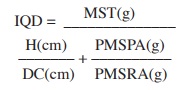
Analyzes the development of seedlings: At the end of the treatments development assessments were carried out, through the variables: number of leaves (NF), height (ALT), root system length (CR), shoot dry weight (MSPA), dry root weight (MSR), stem diameter (DC), Dickson Quality Index (IQD) and the number of plants grown in the field 15 days after the transplant. Each repetition sampled 05 seedlings, which were brought to the Plant Production Laboratory. The counting of the number of leaves was performed (NF) and measurement the stem diameter (DC) with the aid of a digital caliper. The seedling height (ALT) and the root system length (CSR) was obtained with a millimeter ruler. It proceeded to wash in running water for the elimination of the substrate. Then, the seedlings were placed in labeled paper bags for drying in an oven with forced air circulation at 65°C. When the constant weight was reached, the determination was made in analytical balance, the shoot dry weight (MSPA) and the dry root weight (MSR). In the obtaining IQD, the methodology proposed by Freitas et al. (2013) was used, and the indicators of shoot dry weight, root and total dry weight, height and stem diameter of seedlings were considered, according to equation (1):
Where: IQD = Dickson development index, MST = Total dry mass (g), H = height (cm), DC = stem diameter (cm), PMSPA = weight of shoot dry weight (g) and PMSRA = weight of shoot dry weight (g).
The remaining seedlings were transplanted to sites in greenhouse filled with gravel and humus, with spacing of 30 cm each. After 15 days, the survival of the transplanted seedlings was evaluated and it was determined by the amount of developed seedlings.
Statistical analysis: In the statistical analysis the completely randomized design was adopted, with 21 treatments, two witnesses and four replications. Each plot consisted of a quarter of the polystyrene tray with 128 cells. The means were compared by the Scott-Knott test at 5 % probability, using the statistical program SISVAR (Ferreira, 2000)
RESULTS AND DISCUSSION
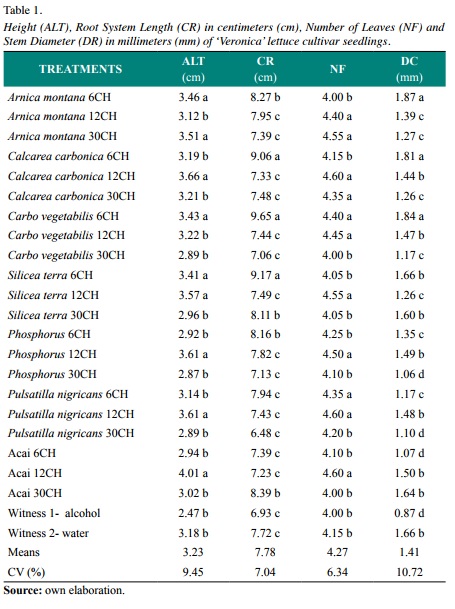
In the development analysis, the variable height was influenced positively in relation to the witnesses by medicines Arnica montana (6CH and 30CH), Calcarea carbonica (12CH), Carbo vegetabilis (6CH), Silicea terra (6CH and 12CH), Phosphorus (12CH), Pulsatilla nigricans (12CH) and the homeopathic preparation of Acai (12CH) (Table 1).
The use of homeopathies in plants has a response effect of a wave form. Therefore, it is essential when experimenting with vegetable homeopathy to work with various powers of a single medicinal product, for in dilution the information of the response in wave is lost Gonçalves, Boff & Boff (2010). However Carvalho, et al. (2005), when working with artemisia plants treated with Arnica montana in different dynamizations did not achieve satisfactory results for the ALT parameter, the same happened with the Grisa's works et al. (2007a), who applied Arnica in different potencies in lettuce plants.
Note that among the treatments that influenced positively the height of seedlings, Acai 12CH was highlighted, for it presented the best value (Table 1), to study the potential of the local resources in the preparation of homeopathies, the inclusion of this preparation was proposed. Andrade & Casali (2011), state that the trial of new homeopathic preparations produced from local resources has great value, because they act as a sustainability strategy, promoting the independence of the producers.
Once the decomposed Acai residues are used as organic fertilizer, because they are rich of carbon Teixeira, Freire de Oliveira, Furlan & Campos (2004), it can be inferred that the increase of ALT in the seedlings treated with homeopathic preparation in 12CH has occurred because it was offered to them the information of the organic matter, via Acai 12CH. This phenomenon is explained by Capra (cited Andrade et al., 2001), which state that matter and energy are equal and interconvertible, changing only the frequency of vibration.
One of the worst performances in the ALT parameter was presented by the witness alcohol at 30% (Table 1). This demonstrates that the signals obtained from the application of the medicines are not influenced by the use of the vehicle. Alcohol is responsible for cell lysis, even being at low concentration (30%) the intoxication information remained, and affected the growth of the seedlings. In the evaluation of the variable CR, Calcarea carbonica, Carbo vegetabilis and Silicea terra, all the 6CH power showed statistically significant differences differing from the two witnesses (Table 1). In this case, should be considered the increase hypothesis of CR due to the Calcarea, Carbo and Sil molecules are still present in the medicine in this power. Only from power 12CH, one extrapolates the Avogadro constant, that is, the homeopathies get probabilistically lacking of molecules instructing the hypothesis dynamic physical effect, as Casali et al. (2006).
Studies related to the root system length were demonstrated by Bonfim et al. (2008) when verified the influence of different dynamizations of Arnica montana in rooting of Rosemary and Lippia alba (lemongrass), they concluded that the power 6CH increased the CR of Rosemary lemongrass. When Hamman, Koning & Him Lok (2003), studied the effects of gibberellic acid dynamised in the germination of barley using 3 lots with 3 levels of force, observed that the lot with the average force increased the length of the roots after the application of homeopathy. It is known that seedling with more developed root length; rather support the transplanting than that one where the shoot is more robust (Karchi et al., 1992).
Regarding to the NF, the Arnica treatments (12CH and 30CH), Calcarea (12CH and 30CH), Carbo (6CH and 12CH), Sil (12CH), Phosphorus (12CH), Puls (6CH and 12CH) and Acai (12CH) were highlighted by presenting greater amount of leaves when compared to other treatments and the witnesses (Table 1).
Similarly, Grisa and contributors (2007a) tested the homeopathic medicine Arnica montana in the 12CH and 30CH potencies in lettuce plants, but they did not obtain significant effects for NF. This contradiction probably reflects the different conditions of sowing and climate experiments.
Satisfactory response to the increased number of leaves was also reported by Datta (2006), when verified the effects of Cinna in combating Meloidgyne incognita on mulberry trees. It is common to observe the same medicine causing different effects, according to the dynamization and species tested, where it can also be observed in this study. For the DC variable, the treatments Arnica montana, Calacarea carbonica and Carbo vegetabilis, all in 6CH power, presented higher statistical results than the other treatments and the two witnesses (Table 1). Whereas the treatments Calcarea 12CH, Carbo 12CH, Silicea 6CH and 30CH, Phosphorus 12CH and Pulsatilla 12CH and Acai 12CH and 30CH showed similar results and witness water, differing only the witness alcohol 30 %. Statistically lower results were observed in seedlings that received the medicines Phosphorus and Pulsatilla nigricans in 30CH, the preparation of Acai in 6CH and the witness alcohol 30 %. The other treatments differed only witness alcohol.
Taiz & Zeiger (2004), reported that the seedlings with greater stem diameter have higher chances of survival after transplanting, since they have greater capacity to formation and growth of new roots. Thus, the DC is a good indicator of development.
In assessing the MSPA parameter, the treatments Arnica montana 6CH, 12CH and 30CH; Pulsatilla nigricans 6CH e 12CH; Calcarea carbonica, Carbo vegetabilis, Silicea terra, Phosphorus and Acai, all in the 12CH, showed up the same witness water, differing only the witness alcohol (Table 2). The others showed equal to each other and the witness alcohol.
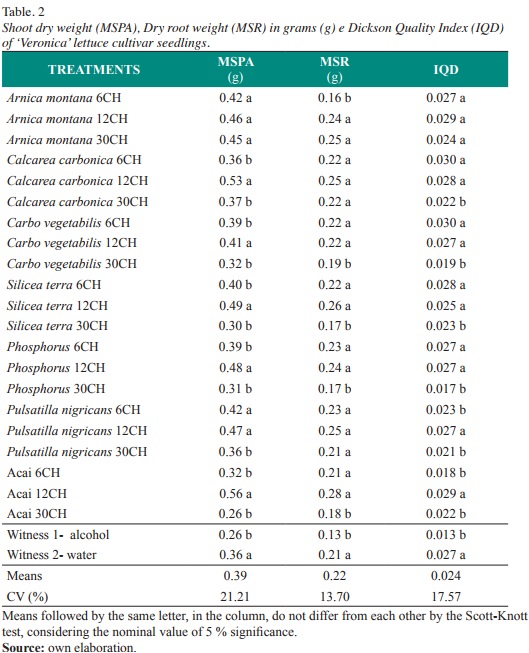
The increase of MSPA through Arnica montana (6CH and 12CH) were also observed by Grisa, Vargas, Cleci de Oliveira & Holz (2007a), in lettuce plants. In this experiment the medicine Carbo vegetabilis, only in the 12CH power, showed satisfactory results, statistically differing from witness alcohol 30 %, and when compared to witness water, it showed a better average, but without statistically significant. This contrast probably reflects the different conditions of seeding, weather and frequency of application, since the same cultivar was used.
In the evaluation of the MSR variable, all the treatments had to be equal, witness water, except Arnica montana 6CH and Carbo vegetabilis, Silicea terra, Phosphorus and Acai both in 30CH that were similar to witness alcohol (Table 2). Satisfactory result for this variable in 12CH dynamization was showed by Grisa et al (2007b) in beet plant subjected to the application of Staphysagria homeopathic medicine.
According to Filgueira (2003), fabrics rich in dry weight (MSR) are favorable for a good rooting and the resumption of plant development after transplantation.
The treatments Arnica montana (6CH, 12CH and 30CH); Calcarea carbonica, Carbo vegetabilis, Silicea terra e Phosphorus (both in 6CH and 12CH); and Pulsatilla nigricans and Acai (both in 12CH) provided the highest values for the IDQ, but they did not differ from witness water, only alcohol 30 % (Table 2). Lower values were presented by the other treatments that did not differ from the witness 1.
Survivals of seedlings after transplanting: After 15 days of transplantation for the beds, it was observed that 100 % of seedlings survived. This survival rate is possibly related to the balance provided by the application of homeopathic medicines and preparations.
CONCLUSION
In the development of analysis it was observed that in almost all parameters evaluated the medicine Carbo vegetabillis 6CH, followed by Calcarea carbonica 12CH, Silicea terra 12CH, Phosphorus 12CH, Pulsatilla nigricans 12CH and the preparation of Acai 12CH contributed to a better performance of the seedlings.
REFERENCIAS
Andrade, F.M.C. y Casali, V.W.D. (2011). Homeopatia, agroecologia e sustentabilidade. Revista Brasileira de Agroecologia, 6(1) 49-56.
Andrade, F. M. C. (2010). Tecnologia e Aplicaçã da Homeopatia na Horticultura. Revista Horticultura Brasileira, 28(2), 85-91.
Andrade, F.M.C. et al. (2001). Efeito de homeopatias no crescimento e na produção de cumarina em chambá (Justicia pectoralis Jacq.). Revista Brasileira de Plantas Medicinais, 4, 19-27.
Bonfim, F.P.G. et al (2008). Use of homeopathic Arnica montana for the issuance off roots os Rosmarinus officinalis L. and Lippia alba (Mill) N.E.Br. International Journal of High Dilution Research, 7(23), 113-117.
Carneiro, S. et al. (2011). Homeopatia princípios e aplicações na Agroecologia. Londrina: IAPAR.
Carvalho, L.M. et al.(2005). Efeito da homeopatia Arnica montana, nas potências centesimais, sobre plantas de artemísia. Revista Brasileira de Plantas Medicinais, 7(3), 33-36.
Casali, V.W.D. et al. (2006). Homeopatia: bases e princípios. Viçosa, MG: Universidade Federal de Viçosa/DFT.
Costa, N. C. C. et al. (2009). Homeopatia: Um campo terapêutico fundamental no cuidado veterinário de animais de produção. Revista SalusGuarapuava (PR),.3(2), 75-89.
Datta, S. C. (2006). Effects of Cina on root-knot disease of mulberry. Homeopathy, 95, 98-102
Ferreira, F. A. (2000). Sistema SISVAR para análises estatísticas. Lavras: Universidade Federal de Lavras.
Filgueira, F. A. R. (2003). Novo manual de olericultura: agrotecnologia moderna na produção e comercialização de hortaliças (2da ed.). Viçosa: UFV.
Gonçalves, P. A. S., Boff, P. & Boff, M. (2010). Preparado homeopático de losna, Artemisia vulgaris L., no manejo de tripes e seu efeito sobre a produção de cebola em sistema orgânico. Rev. Bras. de Agroecologia, Porto Alegre, 5(2), 16-21.
Grisa, S., Vargas, M., Cleci de Oliveira, L. & Holz, L. (2007a) Crescimento e produtividade de alface sob diferentes potências do medicamento homeopático Arnica montana. Revista Brasileira de Agroecologia, Porto Alegre, 2(2), 1050-1053.
Grisa, S., Toledo, M., Cleci de Oliveira, L., Holz, L. & Marine, D. (2007b). Análise quantitativa de plantas de beterraba tratadas com preparados homeopáticos de Staphysagria. Revista Brasileira de Agroecologia, Porto Alegre, 2(2),1046-1049.
Hamman, B., Koning, G. & Him Lok, K. (2003). Homeopathically prepared gibberellic acid and barley seed germintion. Homeopathy, 92, 140- 144.
Karchi, Z., Dagan, A., Cantliffe, D.J. (1992). Growth of containerized lettuce transplants supplemented with varying concentrations of nitrogen and phosphorus. Acta Horticulturae, 319, 367-370. doi: 10.17660/ActaHortic.1992.319.56
Khuda-Bukhsh, A. R. (2006). Laboratory research in homeopathy: pro. Integr. Cancer Ther, 5(4), 320-32. doi: 10.1177/1534735406294794
Londres, F. (2011). Agrotóxicos no Brasil: um guia para ação em defesa da vida. Rio de Janeiro: AS-PTA
Mapeli, N., Silva, R., Dias, W., Cremon, C. & Longo, L., (2010). Repelência de Asciamonusteorseis (Latreille) (Lepidoptera: Pieridae) exposta às soluções homeopáticas. Revista Agrarian,3(8),119-125.
Taiz, L. & Zeiger, E. (2004). Fisiologia Vegetal. Porto Alegre: Artmed Editora S/A
Teixeira, L., Freire de Oliveira, R., Furlan, J. & Campos, V. (2004). Características químicas de composto orgânico produzido com lixo orgânico, caroço de açaì, capim e serragem. Belém: Embrapa Amazônia Oriental.
Tichavsky, M. R. (2007). Manual de Agrohomeopatía. Monte Rei, 2007. Recuperado de: http://redeagroecologia. cnptia.embrapa.br/biblioteca/manejo/homeopatia/ Manual % 20de%20Agrohomeopatia.pdf