

Keywords
ecobrief
footwear
Leather goods
Sustainable Materials
Circular Economy ecobrief
calzado
marroquinería
materiales sostenibles
economía circular
footwear
Leather goods
Sustainable Materials
Circular Economy ecobrief
calzado
marroquinería
materiales sostenibles
economía circular
How to Cite
Uyazan Oviedo, B. D. (2024). ECOBRIEF. A methodological proposal where aesthetics, functionality and sustainability converge. Innmoda Lab, 8(1), 36–64. Retrieved from https://revistas.sena.edu.co/index.php/innlab/article/view/6994
Abstract
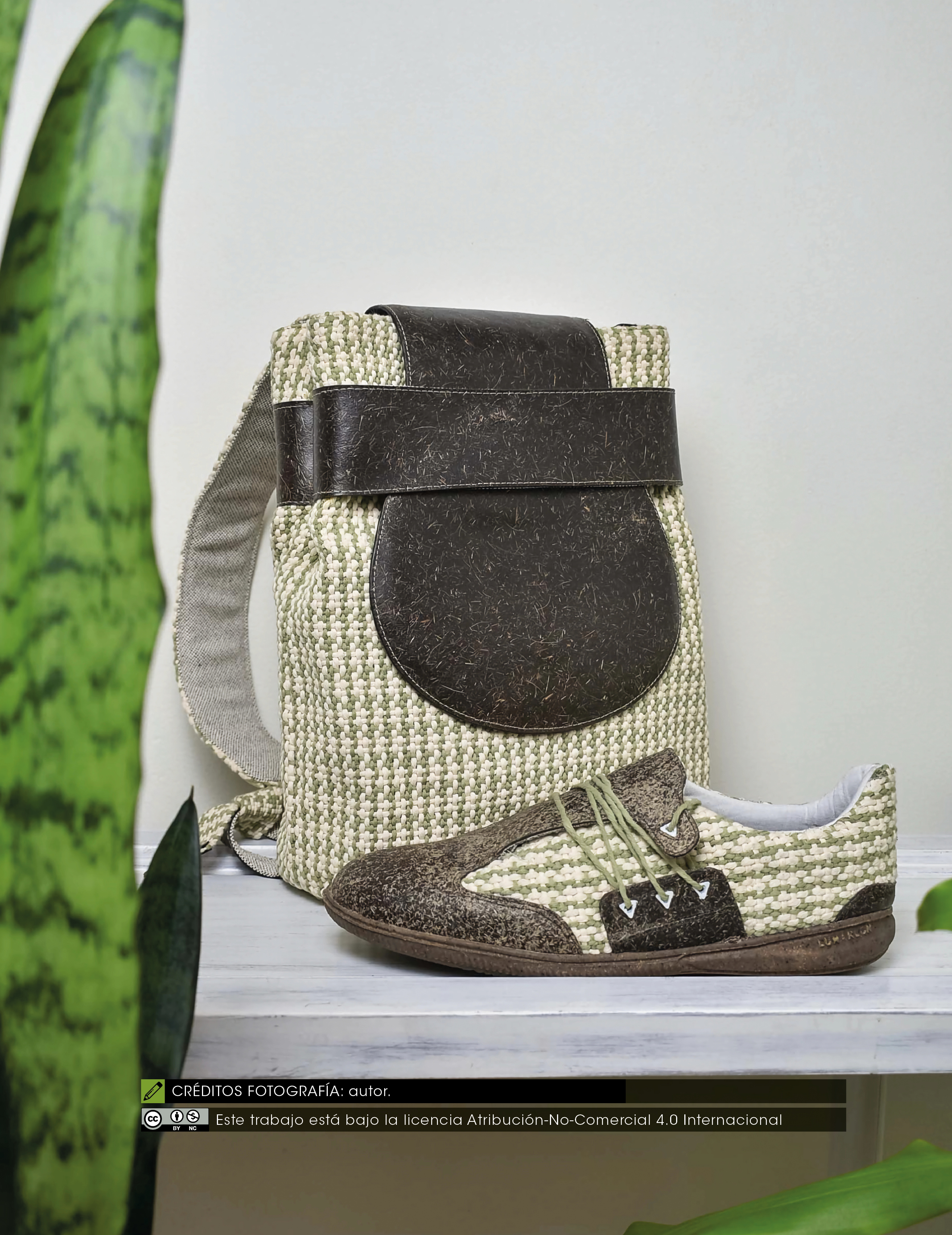
The footwear and leather goods sector faces serious problems arising from the linear economy model, characterized by an excessive use of synthetic materials that, under misused terms such as “vegan leathers”, are marketed as sustainable without actually meeting environmental criteria. This absence of truly sustainable materials highlights the need to rethink current design and production practices. Despite the growth in demand for sustainable products and the demands of more conscious consumers, both from academia and from companies it is difficult to implement tools that allow the development and prototyping of sustainable products in an efficient manner and aligned with market needs. In this context, the ecobrief methodology emerges as an innovative solution. This tool proposes a comprehensive approach that, through different phases, incorporates aesthetics, functionality and sustainability in the design of fashion products in the footwear and leather goods sector. The results demonstrate that the ecobrief can facilitate the transition towards more practical models, offering a practical framework for the creation of products aligned with the principles of the circular economy and the expectations of the modern consumer.
References
Alibaba, R. (2024, June 16). 4 grandes ideas que transformarán la moda en 2026. https://reads.alibaba.com/es/4-big-ideas-transforming-fashion-in-2026/
Centro Tecnológico de Calzado INESCOP. (2021). Materiales Sostenibles La guía que te ayudará a impulsar la sostenibilidad del calzado a través de sus materiales. https://www.inescop.es/images/Proyectos/Regionales/2021/GREENMATSHOE_II/GUIA_MATERIALES_SOSTENIBLES_INESCOP.pdf
Choi, Y. H., & Lee, K. H. (2021). Ethical consumers’ awareness of vegan materials: Focused on fake fur and fake leather. Sustainability (Switzerland), 13(1). https://doi.org/10.3390/su13010436
Compromiso RSE. (2020, February 17). El 61% de los millennials, dispuestos a pagar más por productos sostenibles y ecológicos. https://www.Compromisorse.Com/Rse/2020/02/17/El-61-de-Los-Millennials-Dispuestos-a-Pagar-Mas-Por-Productos-Sostenibles-y-Ecologicos/.
Consultorio Jurídico y Clínicas Jurídicas. (2019, November 19). Situación actual de los plásticos en Colombia y su impacto en el medio ambiente. Https://Derecho.Uniandes.Edu.Co/Informe-Situacion-Actual-de-Los-Plasticos-En-Colombia/.
Cortes Borda, B. S. y Martínez Díaz, S. M. (2017). Gestión ambiental empresarial en el sector de cuero en Bogotá como estrategia competitiva para ingresar al mercado europeo [UNIVERSITARIA AGUSTINIANA]. chrome-extension://efaidnbmnnnibpcajpcglclefindmkaj/https://repositorio.uniagustiniana.edu.co/bitstream/handle/123456789/285/CortesBorda-BrayanSmith-2017.PDF.pdf?sequence=1&isAllowed=y
Presidência do Conselho de Ministros, Brasil. (2022/01/04). Decreto-Lei n.º 3. Diário da República, 1 serie. https://files.diariodarepublica.pt/1s/2022/01/00200/0001500018.pdf?lang=E
Ellen Macarthur Foundation (2012). Hacia Una Economía Circular. Fundación Ellen MacArthur. http://repositorio.ampf.org.ar/greenstone/sites/localsite/collect/economia/index/assoc/D219.dir/hacia-una-ecomomia-circular.pdf
Escuela de negocios, & Camara Sevilla. (2023, October 24). El Desafío de la Moda Rápida: Cómo las Marcas afrontan la Sostenibilidad. Https://En.Camaradesevilla.Com/Moda-Rapida/.
Faludi, J., Hoffenson, S., Kwok, S. Y., Saidani, M., Hallstedt, S. I., Telenko, C., & Martinez, V. (2020). A research roadmap for sustainable design methods and tools. Sustainability (Switzerland), 12(19). https://doi.org/10.3390/su12198174
Fernandez, C. (2018). Conceptos Básicos de Ecodiseño (Vol. 1, pp. 2–10). chrome-extension://efaidnbmnnnibpcajpcglclefindmkaj/http://www.ecosign-project.eu/wp-content/uploads/2018/09/BASIC_UNIT07_ES_Lecture.pdf
Fuertes, K. (2024). Estudio de biotextiles como alternativa sostenible en la industria de la moda en España
[UNIVERSIDAD POLITÉCNICA DE CARTAGENA]. chrome-extension://efaidnbmnnnibpcajpcglclefindmkaj/https://repositorio.upct.es/server/api/core/bitstreams/42422c57-e787-42c9-af3f-1674e20e7cd3/content
Goedkoop, M., Effting, S. y Collignon, M. (s.f.). Anexo Eco-Indicador “99 Método para evaluar el impacto ambiental a lo largo del ciclo de vida.
Gong, Y. & Whelton, J. (2019). In Conversation: Ellen MacArthur: From Linear to Circular. She Ji, 5(3).
Khandai, S., Mathew, J., Yadav, R., Kataria, S. & Kohli, H. (2023). Ensuring brand loyalty for firms practising sustainable marketing: a roadmap. Society and Business Review, 18(2). https://doi.org/10.1108/SBR-10-2021-0189
Manrique, L. (2024). Presentación Taller Materiales Bajo Impacto. https://es.lauramanriquemartinez.com/
Moscoso Barcia, Y. M. (2022). De círculo vicioso a moda circular. Cuadernos Del Centro de Estudios de Diseño y Comunicación, 152. https://doi.org/10.18682/cdc.vi152.6687
Neha, Joshi, P. & Kumar, N. (2024). Sustainable Marketing Initiatives and Consumer Perception of Fast Fashion Brands. Textile and Leather Review, 7. https://doi.org/10.31881/TLR.2023.170
Niinimäki, K., Peters, G., Dahlbo, H., Perry, P., Rissanen, T., & Gwilt, A. (2020). The environmental price of fast fashion. In Nature Reviews Earth and Environment (Vol. 1, Issue 4). https://doi.org/10.1038/s43017-020-0039-9
Pinker Moda. (2023, November 14). AEC y WGSN presentan las tendencias PV 2025. https://pinkermoda.com/aec-y-wgsn-tendencias-pv-2025/
Quantis. (2018). Measuring Fashion: Insights from the Environmental Impact of the Global Apparel and Footwear Industries study. Quantis. chrome-extension://efaidnbmnnnibpcajpcglclefindmkaj/https://quantis.com/wp-content/uploads/2018/03/measuringfashion_globalimpactstudy_full-report_quantis_cwf_2018a.pdf
Quiroga Vergel, Á. V., Cruz Villabón, Y. C., Rojas Sánchez, K. N., Salsarriaga Porras, V. J. y Gomez Villalobos, I. T. (2022). Obtención de filamentos de ABS mezclado con PLA, Almidón, Fique y PP para impresión 3D. Revista Sennova: Revista del Sistema de Ciencia, Tecnología e Innovación. https://doi.org/10.23850/23899573.5355
Raina, S. (2024, January 25). Bringing circularity in the footwear industry. https://india.mongabay.com/2024/01/bringing-circularity-in-the-footwear-industry/
Repsol. (2024). Ciclo de vida de un producto Sostenibilidad y producción pueden ir de la mano. Https://Www.Repsol.Com/Es/Energia-Futuro/Futuro-Planeta/Ciclo-de-Vida-de-Un-Producto/Index.Cshtml?Gad_source=1&gclid=Cj0KCQjwm5e5BhCWARIsANwm06juwJ279wS-10e7Py4Zl9RkGGhMcc0Hkcdhf-72FCGVXBLdrTQI3kIaAo24EALw_wcB.
Santos, D. (2022, March 31). Qué es un brief, para qué sirve y qué tipos existen. Https://Blog.Hubspot.Es/Marketing/Que-Es-Un-Brief.
Xicota, E. (2020, April 6). El cuero, impactos y alternativas más sostenibles. Https://Www.Esterxicota.Com/Cuero-Impactos-Alternativas-Moda-Sostenible/#:~:Text=En%20febrero%20de%202022%2C%20el,De%20pr%C3%A1cticas%20que%20puedan%20distorsionarla.

This work is licensed under a Creative Commons Attribution-NonCommercial-NoDerivatives 4.0 International License.
Copyright (c) 2025 Servicio Nacional de Aprendizaje SENA
Downloads
Download data is not yet available.