
Palabras clave
Circular economy
fashion system
textile waste
recycling Economía circular
Sistema moda
residuos textiles
reciclaje
fashion system
textile waste
recycling Economía circular
Sistema moda
residuos textiles
reciclaje
Cómo citar
Puerto Rico, S. I., Valencia Zapata, M. E., & Puerta Monsalve, A. L. (2023). Avances de la Economía Circular en el Sistema Moda. Innmoda Lab, 7, 46–72. https://doi.org/10.23850/25392379.6189
Resumen
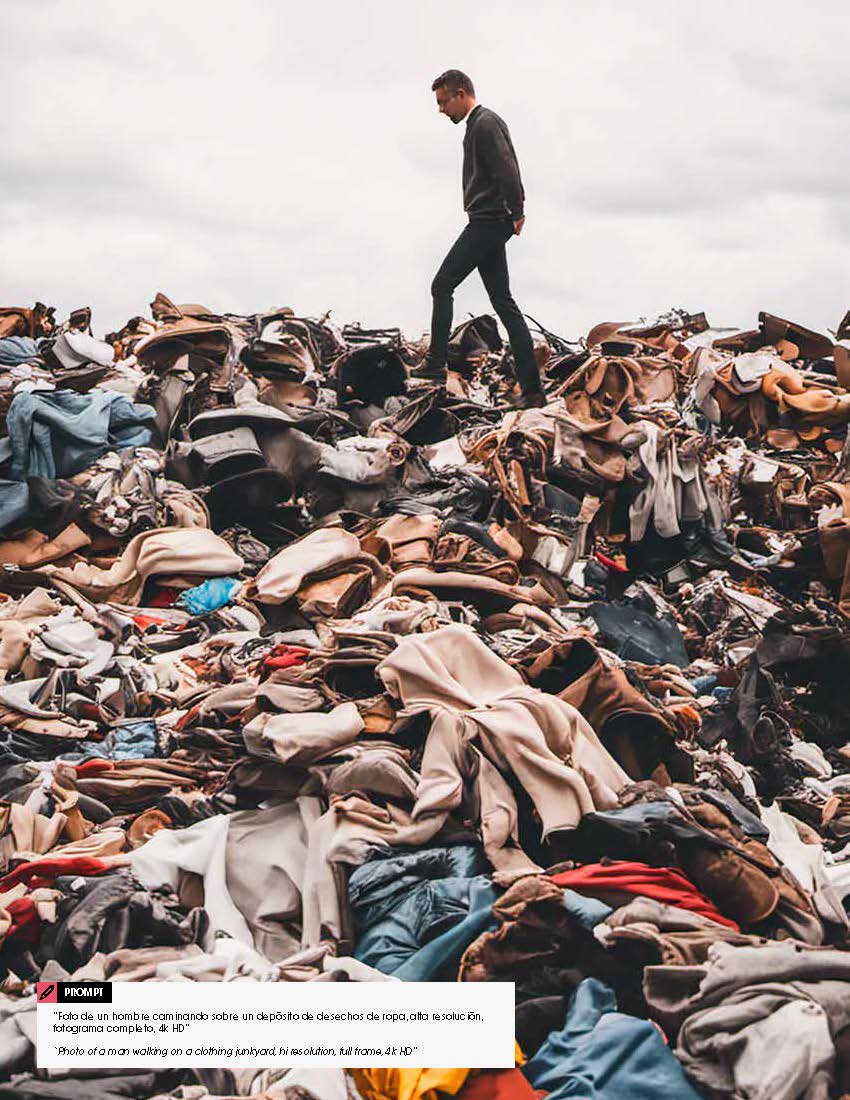
Los residuos generados durante la producción de materiales textiles pueden clasificarse como residuos pre-consumo y post consumo. En la mayoría de los casos, estos residuos se incineran o se arrojan en vertederos, lo que a su vez tiene un factor en el medio ambiente y en el crecimiento económico. Para reducir dichos efectos, hay que tomar medidas de mitigación para adoptar una gestión sostenible de los residuos textiles y frenar el impacto ambiental negativo. En este artículo se presentan los avances que se han producido a nivel mundial en el campo de la economía circular en la moda, y algunas estrategias de valor añadido y aprovechamiento de los residuos. Los avances no solo impactan positivamente el medio ambiente sino que también generan oportunidades económicas y de innovación en la industria textil y de la moda, contribuyendo a un desarrollo sostenible y alineado con los principios de la economía circular.
Citas
Bhanderi, K. K., Joshi, J. R. & Patel, J. V. (2022). Recycling of polyethylene terephthalate (pet or pete) plastics–an alternative to obtain value added products: a review. Journal of the Indian Chemical Society, 100(1), 100843. https://doi.org/10.1016/j.jics.2022.100843
Chaka, K. T. (2021). Beneficiation of textile spinning waste: Production of nonwoven materials. Journal of Natural Fibers, 19(14), 9064-9073. https://doi.org/10.1080/15440478.2021.1982437
Chopra, S. S., Liang, D., Kaur, G., Lens, C.& Lin, C. S. K. (2022). Sustainable process design for circular fashion: Advances in sustainable chemistry for textile waste valorisation. Current Opinion in Green and Sustainable Chemistry, 39, 100747. https://doi.org/10.1016/j.cogsc.2022.100747
Circulose (2023). Is a new material made by recycling cotton from worn-out clothes and production waste? It makes fashion circular. https://circulo.se/en/
Comisión Europea. (2023). Best available techniques (bat) reference document for the Textiles Industry. https://publications.jrc.ec.europa.eu/repository/handle/JRC131874
De Ponte, C., Liscio, M. C. & Sospiro, P. (2023). State of the art on the Nexus between sustainability, fashion industry and sustainable business model. Sustainable Chemistry and Pharmacy, 32, 100968. https://doi.org/10.1016/j.scp.2023.100968
Duhoux, T. et al. (2021). Study on the technical, regulatory, economic and environmental effectiveness of textile fibres recycling. Final Report to the European Commission, Directorate-General for Internal Market, Industry, Entrepreneurship and SMEs. Brussels, Belgium: European Commission. https://policycommons.net/artifacts/2223021/study-on-the-technical-regulatory-economic-and-environmental-effectiveness-of-textile-fibres-recycling/2980453/
Cencig, P. (2021). Durable, repairable and mainstream - How ecodesign can make our textiles circular - ECOS Webinar. ECOS: Environmental Coalition on Standards. Belgium, Brussels. https://policycommons.net/artifacts/3330044/durable-repairable-and-mainstream/4128854/on
Econyl (2023). Endless Possibilities. regenerated nylon. https://www.econyl.com/discover-econyl/
Ellen Macarthur Foundation. (2013). Circular Economy. https://ellenmacarthurfoundation.org/topics/circular-economy-introduction/
Ellen Macarthur Foundation. (2021). The Jeans Redesign. https://ellenmacarthurfoundation.org/the-jeans-redesign
Gatzer, S., Helmcke, S. & Roos, D. (2022/06/29). Playing offense on circularity can net European consumer goods companies €500 billion. McKinsey and Company. https://www.mckinsey.com/industries/consumer-packaged-goods/our-insights/playing-offense-on-circularity-can-net-european-consumer-goods-companies-500-billion-euros
Icicle (2023). Icicle group. https://www.icicle.com.cn/en/icicle-group/
Industrial Emissions Directive (IED) (2021). Assessment of options for the revision of the Industrial Emissions Directive. https://environment.ec.europa.eu/topics/industrial-emissions-and-safety/industrial-emissions-directive
Leff, E. (2022). Racionalidad ambiental: la reapropiación social de la naturaleza. Ciudad de México, México: Siglo XXI Editores.
Lu, L., Fan, W., Meng, X., Xue, L., Ge, S., Wang, C. & Lam, S. S. (2023). Current recycling strategies and high-value utilization of waste cotton. Science of The Total Environment, 856, 158798. https://doi.org/10.1016/j.scitotenv.2022.158798
Organización de Naciones Unidas (ONU). (2015/12/12). Acuerdo de París de la Convención Marco de las Naciones Unidas sobre el Cambio Climático (UNFCCC). https://www.refworld.org/es/leg/multilateraltreaty/un/2015/es/134497
Organización de las Naciones Unidas (ONU). (2019).El costo ambiental de estar a la moda. Noticias onu,2019. https://news.un.org/es/story/2019/04/145820194161
Schmutz, M., & Som, C. (2022). Identifying the potential for circularity of industrial textile waste generated within Swiss companies. Resources, Conservation and Recycling, 182, 106132. https://doi.org/10.1016/j.resconrec.2021.106132
Suhaimi, N.A.S., Muhamad, F., Abd Razak, N.A. & Zeimaran, E. (2022). Recycling of polyethylene terephthalate wastes: A review of technologies, routes, and applications. Polymer Engineering & Science, 62(8), 2355-2375. https://doi.org/10.1002/pen.26017
Todor, M. P., Rackov, M., Kiss, I. & Cioata, V. G. (2022/02). Composite solutions with recycled textile wastes. Journal of Physics: Conference Series, 2212, 012030. https://iopscience.iop.org/article/10.1088/1742-6596/2212/1/012030/meta
Sun, X. et al. (2022). Injectable bioactive polymethyl methacrylate–hydrogel hybrid bone cement loaded with bmp-2 to improve osteogenesis for percutaneous vertebroplasty and kyphoplasty. Bio-Design and Manufacturing, 5(2), 318-332. https://doi.org/10.1007/s42242-021-00172-1
Ribul, M., Lanot, A., Pisapia, C. T., Purnell, P., Mc-Queen-Mason, S. J. & Baurley, S. (2021). Mechanical, chemical, biological: Moving towards closedloop biobased recycling in a circular economy of sustainable textiles. Journal of Cleaner Production, 326, 129325. https://doi.org/10.1016/j.jclepro.2021.129325
United Nations Climate Change (UNFCCC) (2021). Fashion Industry Charter for Climate Action. Industry Charter Fashion and Climate Action, 2021. https://unfccc.int.com

Esta obra está bajo una licencia internacional Creative Commons Atribución-NoComercial-SinDerivadas 4.0.
Derechos de autor 2023 Servicio Nacional de Aprendizaje SENA
Descargas
Los datos de descargas todavía no están disponibles.