
Keywords
Circular economy
fashion system
textile waste
recycling Economía circular
Sistema moda
residuos textiles
reciclaje
How to Cite
Puerto Rico, S. I., Valencia Zapata, M. E., & Puerta Monsalve, A. L. (2023). Advances in Circular Economy in the Fashion System. Innmoda Lab, 7, 46–72. https://doi.org/10.23850/25392379.6189
Abstract
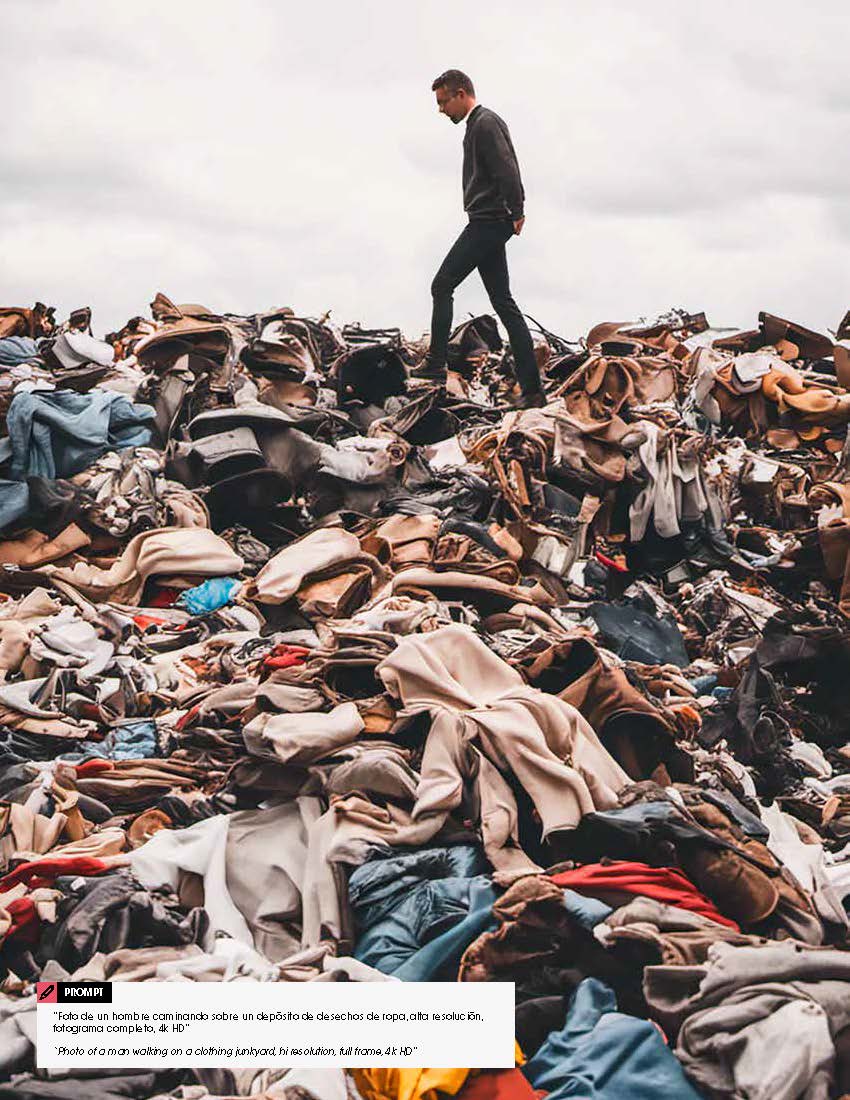
The waste generated during the production of textile materials can be classified as pre-consumer and post-consumer waste. In most cases, these wastes are incinerated or disposed of in landfills, which, in turn, has an impact on the environment and economic growth. To reduce these effects, mitigation measures must be taken to adopt sustainable management of textile waste and curb the negative environmental impact. This article presents the global advances in the field of circular economy in fashion, along with some value-added strategies and waste utilization. These advances not only positively impact the environment but also create economic and innovation opportunities in the textile and fashion industry, contributing to sustainable development aligned with the principles of the circular economy.
References
Bhanderi, K. K., Joshi, J. R. & Patel, J. V. (2022). Recycling of polyethylene terephthalate (pet or pete) plastics–an alternative to obtain value added products: a review. Journal of the Indian Chemical Society, 100(1), 100843. https://doi.org/10.1016/j.jics.2022.100843
Chaka, K. T. (2021). Beneficiation of textile spinning waste: Production of nonwoven materials. Journal of Natural Fibers, 19(14), 9064-9073. https://doi.org/10.1080/15440478.2021.1982437
Chopra, S. S., Liang, D., Kaur, G., Lens, C.& Lin, C. S. K. (2022). Sustainable process design for circular fashion: Advances in sustainable chemistry for textile waste valorisation. Current Opinion in Green and Sustainable Chemistry, 39, 100747. https://doi.org/10.1016/j.cogsc.2022.100747
Circulose (2023). Is a new material made by recycling cotton from worn-out clothes and production waste? It makes fashion circular. https://circulo.se/en/
Comisión Europea. (2023). Best available techniques (bat) reference document for the Textiles Industry. https://publications.jrc.ec.europa.eu/repository/handle/JRC131874
De Ponte, C., Liscio, M. C. & Sospiro, P. (2023). State of the art on the Nexus between sustainability, fashion industry and sustainable business model. Sustainable Chemistry and Pharmacy, 32, 100968. https://doi.org/10.1016/j.scp.2023.100968
Duhoux, T. et al. (2021). Study on the technical, regulatory, economic and environmental effectiveness of textile fibres recycling. Final Report to the European Commission, Directorate-General for Internal Market, Industry, Entrepreneurship and SMEs. Brussels, Belgium: European Commission. https://policycommons.net/artifacts/2223021/study-on-the-technical-regulatory-economic-and-environmental-effectiveness-of-textile-fibres-recycling/2980453/
Cencig, P. (2021). Durable, repairable and mainstream - How ecodesign can make our textiles circular - ECOS Webinar. ECOS: Environmental Coalition on Standards. Belgium, Brussels. https://policycommons.net/artifacts/3330044/durable-repairable-and-mainstream/4128854/on
Econyl (2023). Endless Possibilities. regenerated nylon. https://www.econyl.com/discover-econyl/
Ellen Macarthur Foundation. (2013). Circular Economy. https://ellenmacarthurfoundation.org/topics/circular-economy-introduction/
Ellen Macarthur Foundation. (2021). The Jeans Redesign. https://ellenmacarthurfoundation.org/the-jeans-redesign
Gatzer, S., Helmcke, S. & Roos, D. (2022/06/29). Playing offense on circularity can net European consumer goods companies €500 billion. McKinsey and Company. https://www.mckinsey.com/industries/consumer-packaged-goods/our-insights/playing-offense-on-circularity-can-net-european-consumer-goods-companies-500-billion-euros
Icicle (2023). Icicle group. https://www.icicle.com.cn/en/icicle-group/
Industrial Emissions Directive (IED) (2021). Assessment of options for the revision of the Industrial Emissions Directive. https://environment.ec.europa.eu/topics/industrial-emissions-and-safety/industrial-emissions-directive
Leff, E. (2022). Racionalidad ambiental: la reapropiación social de la naturaleza. Ciudad de México, México: Siglo XXI Editores.
Lu, L., Fan, W., Meng, X., Xue, L., Ge, S., Wang, C. & Lam, S. S. (2023). Current recycling strategies and high-value utilization of waste cotton. Science of The Total Environment, 856, 158798. https://doi.org/10.1016/j.scitotenv.2022.158798
Organización de Naciones Unidas (ONU). (2015/12/12). Acuerdo de París de la Convención Marco de las Naciones Unidas sobre el Cambio Climático (UNFCCC). https://www.refworld.org/es/leg/multilateraltreaty/un/2015/es/134497
Organización de las Naciones Unidas (ONU). (2019).El costo ambiental de estar a la moda. Noticias onu,2019. https://news.un.org/es/story/2019/04/145820194161
Schmutz, M., & Som, C. (2022). Identifying the potential for circularity of industrial textile waste generated within Swiss companies. Resources, Conservation and Recycling, 182, 106132. https://doi.org/10.1016/j.resconrec.2021.106132
Suhaimi, N.A.S., Muhamad, F., Abd Razak, N.A. & Zeimaran, E. (2022). Recycling of polyethylene terephthalate wastes: A review of technologies, routes, and applications. Polymer Engineering & Science, 62(8), 2355-2375. https://doi.org/10.1002/pen.26017
Todor, M. P., Rackov, M., Kiss, I. & Cioata, V. G. (2022/02). Composite solutions with recycled textile wastes. Journal of Physics: Conference Series, 2212, 012030. https://iopscience.iop.org/article/10.1088/1742-6596/2212/1/012030/meta
Sun, X. et al. (2022). Injectable bioactive polymethyl methacrylate–hydrogel hybrid bone cement loaded with bmp-2 to improve osteogenesis for percutaneous vertebroplasty and kyphoplasty. Bio-Design and Manufacturing, 5(2), 318-332. https://doi.org/10.1007/s42242-021-00172-1
Ribul, M., Lanot, A., Pisapia, C. T., Purnell, P., Mc-Queen-Mason, S. J. & Baurley, S. (2021). Mechanical, chemical, biological: Moving towards closedloop biobased recycling in a circular economy of sustainable textiles. Journal of Cleaner Production, 326, 129325. https://doi.org/10.1016/j.jclepro.2021.129325
United Nations Climate Change (UNFCCC) (2021). Fashion Industry Charter for Climate Action. Industry Charter Fashion and Climate Action, 2021. https://unfccc.int.com

This work is licensed under a Creative Commons Attribution-NonCommercial-NoDerivatives 4.0 International License.
Copyright (c) 2023 Servicio Nacional de Aprendizaje SENA
Downloads
Download data is not yet available.