
How to Cite
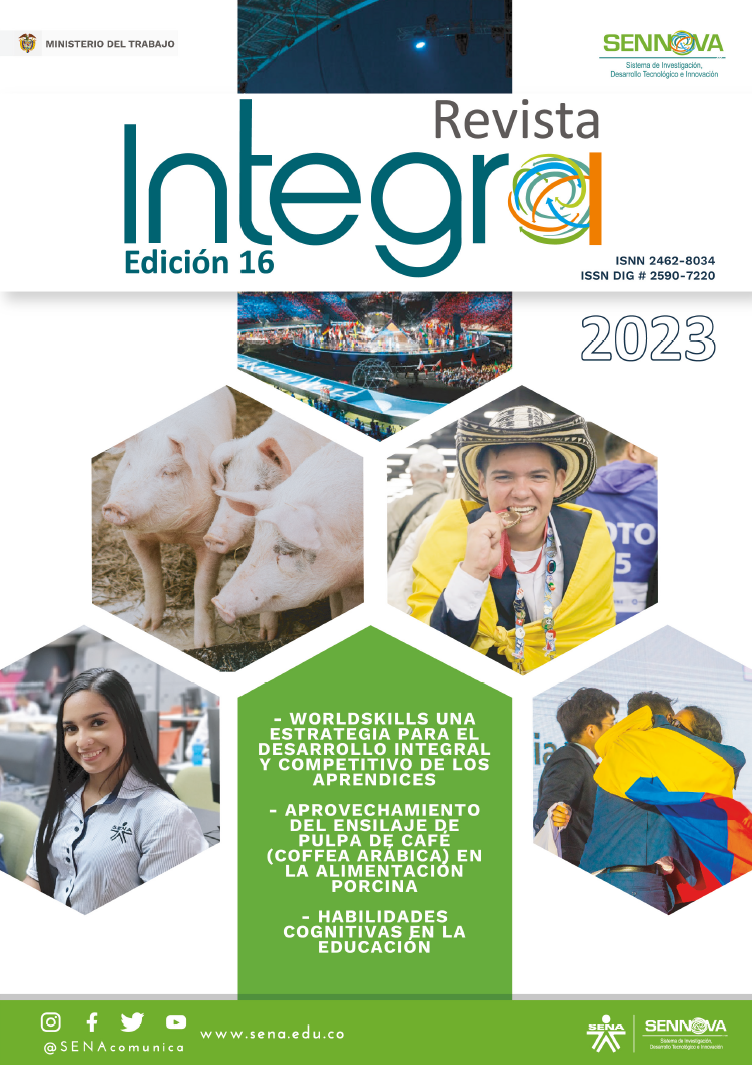
Ortega Jaime, W. A., & Galvis Parra, Y. M. (2024). WORLDSKILLS UNA ESTRATEGIA PARA EL DESARROLLO INTEGRAL Y COMPETITIVO DE LOS APRENDICES SENA EN EL CENTRO DE SERVICIOS EMPRESARIALES Y TURISTICOS DE BUCARAMANGA. Revista Integra: Investigación Aplicada, Desarrollo Tecnológico E Innovación, 16. https://doi.org/10.23850/24628034.6308
Abstract
The World Skills strategy was born from the first international competition of professional training that took place in 1950 in the educational institution Virgen de la Paloma, in Madrid, at the initiative of the Spanish organizers headed by Francisco Albert Vidal and with the participation of 12 young professionals from Spain and Portugal.
Three years later, in 1953, a new international competition also organised in Madrid included the participation of Germany, Great Britain, France, Morocco and Switzerland.
And it was in 1954 that the first Organising Council was set up, formed by representatives from the participating countries, with the aim of establishing the rules and protocols for these international competitions.
Since then and until today, 79 countries are members of the international organisation World Skills, which, by organising the international vocational training competition every two years, promotes the professional excellence of our young people, supports the development of their skills, and enables the dissemination of vocational training worldwide.
World Skills International, is an organization whose main objective is to improve the standards and norms of training for work worldwide, through international competitions where technical and technological skills are measured through practical projects that are developed every two years in different scenarios, where more than 70 countries representing different vocational training entities meet.
The given realities in Colombia that do not constitute positive changes generate backwardness, hinder growth, and of course continue to attract destabilising phenomena for a country. Training for work is the main factor of competitiveness that is presented to the real productive sector of a nation.
The persistent demand of the global and domestic economic sectors generates technological and innovative advances that require highly trained and qualified human talent to respond to the needs and opportunities that the productive sectors require.
The development and application of new learning methodologies and strategies, in accordance with businesses needs of the productivity and competitiveness needs of, which would allow investment in the social and technical development of Colombian workers, offering and executing Comprehensive Vocational Training, for the incorporation and social, economic and technological development of the country.
Under this line, the biggest challenge to SENA Regional Santander and especially for the Centro de Servicios Empresariales y Turisticos Bucaramanga, for the period 2023 - 2030, is to identify and incorporate permanently in the management, the needs and advances in training, coverage, relevance, quality and internationalisation in aspects of technical and technological training and preparation of people in various sectors; not only at the national level but in articulation with the demand resultant from international scenarios, in order to promote social and productive inclusion that Colombia requires.
For this reason, the WorldSkills strategy is a fundamental tool for the quality assurance of the Integral Vocational Training Directorate of the Servicio Nacional de Aprendizaje - SENA and the Centro de Servicios Empresariales y Turisticos Bucaramanga from Santander Regional Office, through an alliance with the World Skills International organisation.
The strategy is based on three fundamental axes that radiate in the Integral Vocational Training provided by the institution: more quality, more productivity and competences.

This work is licensed under a Creative Commons Attribution-NonCommercial-ShareAlike 4.0 International License.
Downloads
Download data is not yet available.