Keywords
moda rápida
impacto ambiental
industra textil
logística inversa
programación lineal
ruteo de vehículos circular economy
Environmental impact
fast fashion
textile industry
reverse logistics
linear programming
vehicle routing
How to Cite
Abstract
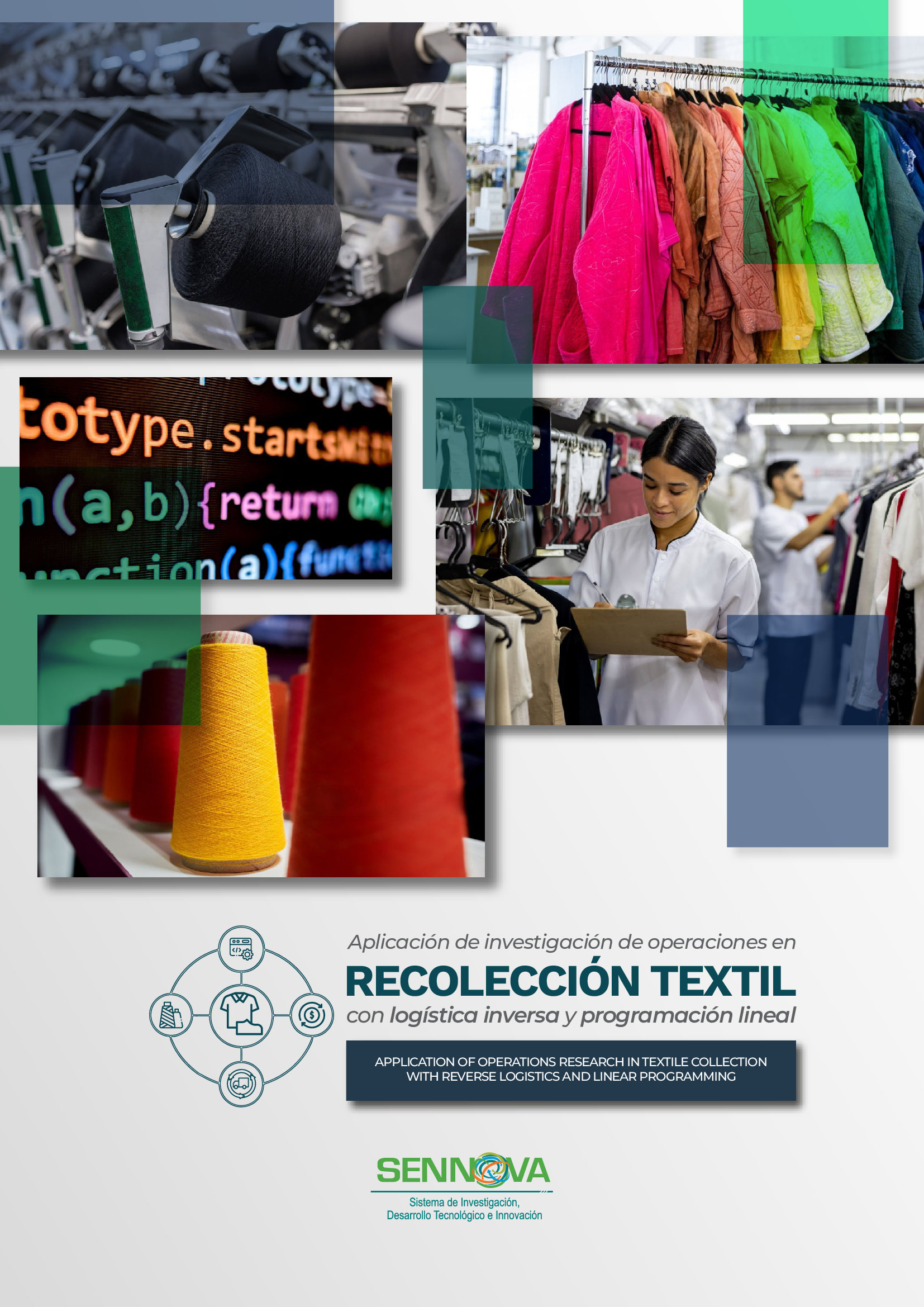
The textile industry faces serious environmental challenges, particularly due to the "Fast Fashion" model, which is characterized by the mass production of clothing with a short lifecycle. This model promotes a "use-and-dispose" culture that generates a significant amount of textile waste and challenges the principles of the Circular Economy, which aims to extend the life of products and reincorporate materials into the industrial system. This article proposes reverse logistics as a solution to mitigate this problem, focusing on strategies such as remanufacturing and recycling. Through the use of linear programming applied to the Vehicle Routing Problem (VRP), it examines how to optimize post-consumer textile collection routes. The results show that efficient route planning can reduce costs and improve collection, significantly contributing to waste reduction and environmental impact. The study highlights the importance of implementing reverse logistics strategies in the textile industry to adhere to Circular Economy principles and mitigate the negative effects of fast fashion.
References
Acosta Calderón, S. N., & Velandia Sarmiento, D.
F. (2022). Metodologia para la aplicación
de economia circular y logistica inversa
en el algodón para la industria textil en
Bogotá. https://repository.uamerica.edu.
co/items/903ceed5-77d0-4301-a1ad
b349e7abb6b
Cai, Y.-J., & Choi, T.-M. (2020). A United Nations’ Sustainable Development Goals perspective for sustainable textile and apparel supply chain management. TRANSPORTATION RESEARCH PART E-LOGISTICS AND TRANSPORTATION REVIEW, 141. https://doi.org/10.1016/j.tre.2020.102010
Dissanayake, K., & Pal, R. (2023). Sustainability dichotomies of used clothes supply chains: a critical review of key concerns and strategic resources. INTERNATIONAL JOURNAL OF LOGISTICS MANAGEMENT, 34(7), 75–97. https://doi.org/10.1108/IJLM-10-2022-0410
Garcia, S., Naas, I. de A., Neto, P. L. de O. C., dos Reis, J. G. M., Polvora, V. N., de Lima, L. A., Martinez, A. A. G., & Lessa, V. S. (2020). Sustainability in Fabric Chains and Garments for a Circular Economy. En B. Lalic, U. Marjanovic, D. Romero, V. Majstorovic, & G. VonCieminski (Eds.), ADVANCES IN PRODUCTION MANAGEMENT SYSTEMS: THE PATH TO DIGITAL TRANSFORMATION AND INNOVATION OF PRODUCTION MANAGEMENT SYSTEMS, PT I (Vol. 591, pp. 531–537). https://doi.org/10.1007/978-3-030-57993-7_60
González-Castillo, N. S., Núñez-Rodr’iguez, J., & Ram’irez-Rojas, M. S. (2023). Implicación de la logistica inversa en la sostenibilidad del sector textil: una revisión sistemática. I+ D Revista de Investigaciones, 18(1), 16–44.
Hinkka, V., Aminoff, A., Palmgren, R., & Heikkila Pirjo and Harlin, A. (2023). Investigating postponement and speculation approaches to the end-of-life textile supply chain. JOURNAL OF CLEANER PRODUCTION, 422. https://doi.org/10.1016/j.jclepro.2023.138431
Jaamaa, L., & Kaipia, R. (2022). The first mile problem in the circular economy supply chains-Collecting recyclable textiles from consumers. WASTE MANAGEMENT, 141, 173–182. https://doi.org/10.1016/j.wasman.2022.01.012
Larrañeta, J. (1987). Programación lineal y grafos (Número 1). Universidad de Sevilla.
Machuca-de-Pina, J. M., Dorin, M., & Garc’ia-Yi, A.-I. (2018). Evaluación experimental de un modelo de programación lineal para el problema de ruteo de vehiculos (VRP). Interfases, 011, 103–117.
Oh, J., & Jeong, B. (2014). Profit Analysis and Supply Chain Planning Model for Closed-Loop Supply Chain in Fashion Industry. SUSTAINABILITY, 6(12), 9027–9056. https://doi.org/10.3390/su6129027
Paras, M. K., Ekwall, D., Pal, R., Curteza, A., Chen, Y., & Wang, L. (2018). An Exploratory Study of Swedish Charities to Develop a Model for the Reuse-Based Clothing Value Chain. SUSTAINABILITY, 10(4). https://doi.org/10.3390/su10041176
Roberts, H., Milios, L., Mont, O., & Dalhammar, C. (2023). Product destruction: Exploring unsustainable production-consumption systems and appropriate policy responses. SUSTAINABLE PRODUCTION AND CONSUMPTION, 35, 300–312. https://doi.org/10.1016/j.spc.2022.11.009
Sumo, P. D., Alimo, P. K., Agyeman, S., Sumo, D. Z., Cai, L., & Ji, X. (2023). RESEARCH OPPORTUNITIES IN TEXTILE REVERSE LOGISTICS: A SYSTEMATIC REVIEW. LOGFORUM, 19(2), 303–315. https://doi.org/10.17270/J.LOG.2023.841
Yavari, R. (2019). Analysis of a Garment-oriented Textile Recycling System via Simulation Approach.
Zhuravleva, A. (2024). Reverse supply chains of non-profit organizations for textile reuse. JOURNAL OF HUMANITARIAN LOGISTICS AND SUPPLY CHAIN MANAGEMENT. https://doi.org/10.1108/JHLSCM-03-2023-0018

This work is licensed under a Creative Commons Attribution-NonCommercial-ShareAlike 4.0 International License.
Copyright (c) 2025 Revista Teinnova